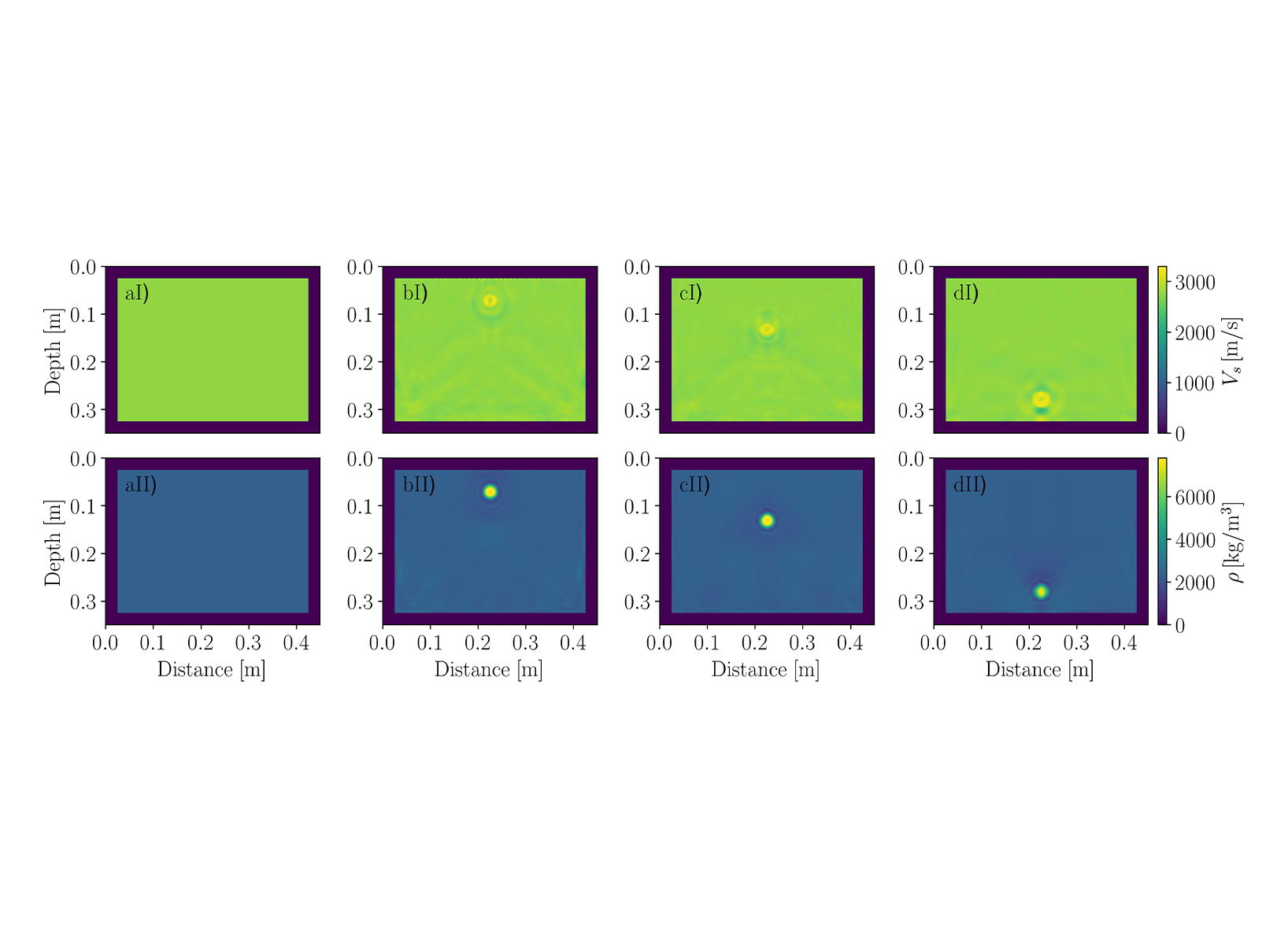
 Starting model (aI, aII), FWI-reconstructed shear-wave velocity (bI–dI) and density (bII–dII) models for synthetic data with a 3cm embedded rebar at the central position at increasing depths
 Ultrasonic measurements are widely used in non-destructive testing (NDT) and structural health monitoring (SHM) to assess the safety of critical infrastructure. However, the inherently high heterogeneity of concrete, combined with the technical features of measurement devices, poses significant challenges for the application of more detailed imaging methods in NDT.
To improve imaging of complex concrete interiors, advanced geophysical imaging techniques can be combined with conventional NDT methods. This project invistigates possibilities of full waveform inversion (FWI) to improve the resolution and reliability of internal structure reconstruction. FWI uses the full recorded wavefield and involves many repeated forward and adjoint wavefield simulations on fine numerical grids suitable for ultrasonic frequencies. Therefore, HPC resources are required.
Project Details
Project term
May 1, 2025–April 30, 2026
Affiliations
RWTH Aachen University
Institute
Institute for Applied Geophysics and Geothermal Energy
Principal Investigator
Methods
FWI is a nonlinear, iterative optimization method that estimates the spatial distribution of elastic material parameters by minimizing the difference between the observed and modeled wave fields. This project uses the open-source, C-based DENISE code for the physics of two-dimensional elastic SH waves. Wave propagation is simulated in the time domain using a finite-difference stress–velocity formulation.
The misfit between the observed and modeled data is minimized using a global correlation norm. Gradients are computed using the adjoint-state method, and model updates are performed with a preconditioned conjugate gradient optimization scheme and line search.
The general workflow consists of defining an initial model, performing forward modeling, computing residuals, back-propagating the adjoint wavefield, calculating and preconditioning gradients, updating the model parameters, and repeating these steps until convergence or a predefined stopping criterion is met.
Results
Synthetic inversion tests were performed on small concrete models containing single steel rebar of various diameters and positions. The results demonstrate that full wave inversion can accurately reconstruct the location and shape of embedded steel bars, especially those with diameters of 20 mm or greater. The averaged reconstructed shear-wave velocity values inside the rebar contours showed a relative error of less than 5% from the true value for the investigated synthetic cases. However, density reconstruction was less accurate, indicating that density is more difficult to recover reliably.
Additionally, the first elastic FWI tests with real ultrasonic data were conducted. FWI was applied to 2D data acquired from a 85 × 30 × 70 cm concrete specimen containing four 3 cm diameter steel rebars. As expected from the synthetic tests, the density values were underestimated by 36%, but the shear-wave velocity was recovered reliably. However, this phase of the project is not yet finished.
Discussion
The current stage of the project demonstrates the significant potential of full waveform inversion for ultrasonic imaging of concrete structures. Compared to conventional imaging approaches in NDT, FWI considers the entire wavefield and provides information about not only the location of objects, but also the elastic characteristics of materials.
However, real-data results show that ultrasonic FWI is still a challenging technique. Strong scattering and attenuation of concrete, uncertain source characteristics, coupling effects, and a limited acquisition aperture can lead to artefacts and reduced sensitivity to very shallow and deep objects. Therefore, future work will focus on improving the FWI workflow, testing alternative approaches for determining appropriate starting models, and increasing inversion robustness.
Additional Project Information
DFG classification: 410-04 Structural Engineering, Building Informatics and Construction Operation
Software: DEENISE-Black-EditionPublic
Cluster: CLAIX