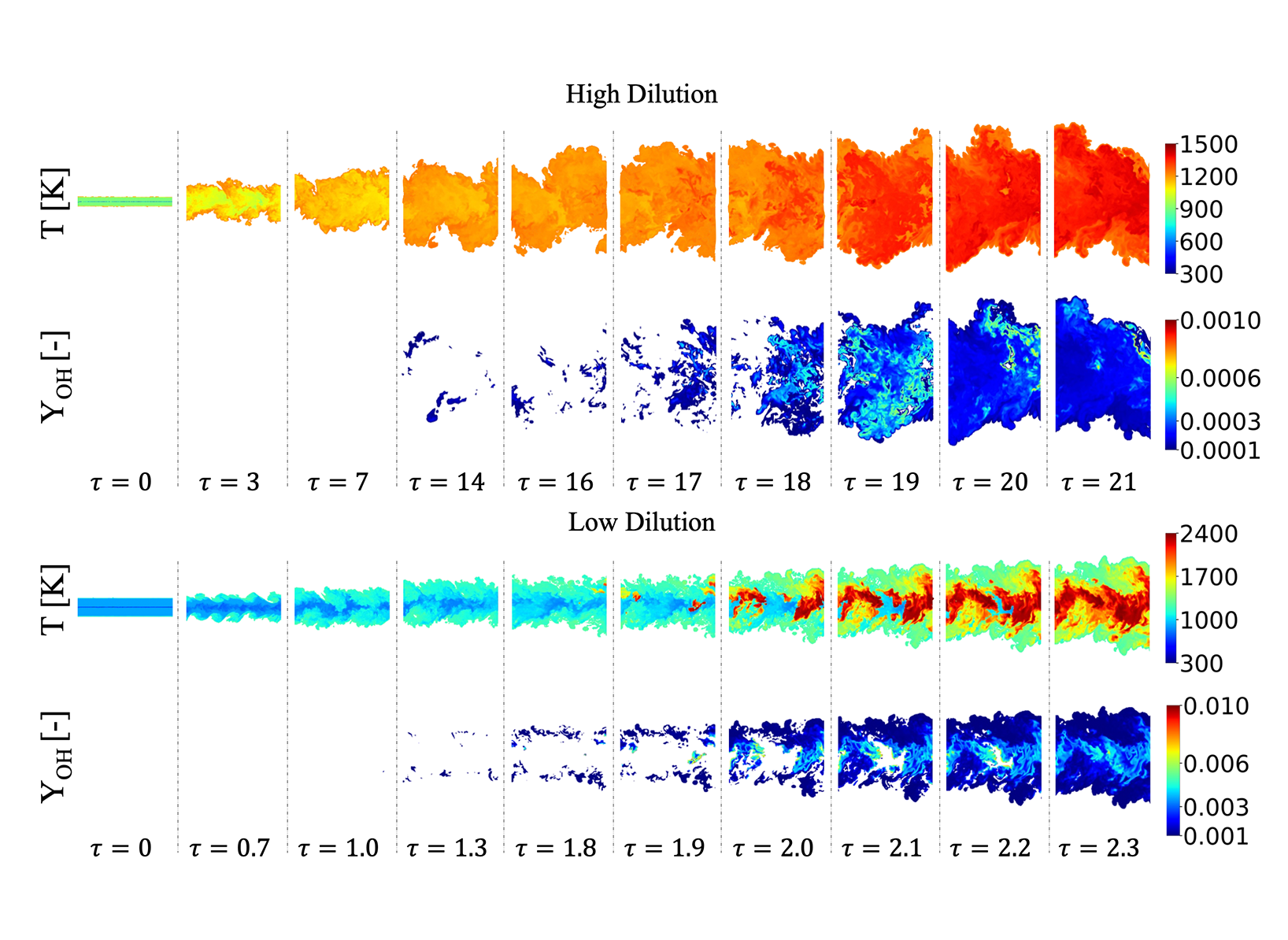
 Two-dimensional temperature and OH mass fraction field slices for high-dilution (top) and low-dilution (bottom) fast-fuel mixing cases at representative time instants.
 MILD (Moderate or Intense Low-oxygen Dilution) combustion is a promising technology for industrial high-temperature processes, enabling stable, low-emission operation by strongly preheating and diluting reactants with recirculated hot combustion products prior to ignition. This leads to distributed reaction zones, reduced peak temperatures, and suppressed NO formation. Understanding how multi-stream mixing governs ignition and combustion regime in MILD conditions is essential for model development. DNS is the ideal tool to resolve all relevant scales without turbulence or combustion submodels. The present project performed a DNS of a temporally evolving three-stream mixing layer — fuel, air, and hot combustion products — using the NHR4CES CLAIX supercomputer, which was essential to afford the large computational grids (1.2 billion cells) required to resolve Kolmogorov scales and OH reaction layers at the target Reynolds numbers.
Project Details
Project term
November 8, 2024–March 13, 2026
Affiliations
RWTH Aachen University
Institute
Institute for Combustion Technology (ITV)
Principal Investigator
Methods
Two DNS cases of a temporally evolving mixing layer were performed: one under MILD conditions (high dilution, HD) and one under non-MILD conditions (low dilution, LD). Both cases use a 25%/75% H/CH fuel jet at K, preheated air at K, and hot equilibrium combustion products at K,with a global equivalence ratio . Initial thermochemical fields were mapped from 1D non-premixed flamelet solutions at extinction conditions, ensuring a quasi-frozen state that allows capturing the onset of autoignition. The reactive Navier-Stokes equations in the low-Mach limit were solved using the in-house finite-difference solver CIAO, with a reduced kinetic mechanism of 24 species and 251 reactions. The HD case uses a compact domain (1.2 billion cells) with fast fuel-air and hot products-air mixing (), while the LD case uses a larger domain (0.7 billion cells) with slow hot-products mixing (). Combustion mode characterization employed Chemical Explosive Mode Analysis (CEMA), based on the eigenvalues of the chemical source term Jacobian , and the local Flame Index (FI), defined as , to distinguish autoignition from deflagration and premixed from diffusion-dominated regions.
Results
The HD case satisfies the Cavaliere-de Joannon MILD criterion, with K against K and a self-ignition temperature of 866 K (i.e.\). Ignition is spatially distributed, OH radicals spread throughout the domain, and the mean temperature rises gradually. The LD case reaches peak temperatures of 2470 K, well above the MILD threshold, with localized reactive layers and sharp OH gradients typical of conventional turbulent flames. CEMA analysis at ignition time shows that in the HD case the domain is dominated by autoignition regions (), whereas the LD case exhibits a broader distribution of deflagration () and extinction () zones. Combined CEMA–FI analysis of the fractional heat release rate (HRR) confirms that in the MILD case more than 90% of total HRR originates from premixed-autoignition regions, with negligible deflagrative and diffusive contributions. In the non-MILD case, deflagrative contributions rise to 9%, consistent with the formation of localized reactive layers. Scalar dissipation rate analysis reveals that in the MILD case both and exhibit distinct distributions between autoignition and deflagration zones, while in the non-MILD case only influences the combustion mode, with playing a negligible role.
Discussion
The results demonstrate that the transition to MILD combustion is governed by the ratio between the hot-products mixing time and the minimum ignition delay time . When this ratio is low (HD case), intense dilution and preheating produce a nearly uniform thermochemical environment: most of the domain reaches autoignition conditions simultaneously, resulting in volumetric, autoignition-dominated heat release with 0D-reactor-like behavior. When dilution is insufficient (LD case), thermal and compositional stratification persists at ignition, promoting localized flame propagation and increasing deflagrative HRR contributions. The sensitivity of MILD combustion to both and underscores the critical role of recirculated products mixing in governing distributed ignition (a feature absent in non-MILD regimes), where fuel mixing alone controls the autoignition-deflagration balance. These findings highlight the need for flexible combustion models capable of capturing both regimes: autoignition-chemistry-based closures are sufficient under MILD conditions but must explicitly account for hot-products mixing; non-MILD frameworks additionally require flame-propagation dynamics. Future work will extend this dataset to different fuel compositions and dilution levels to further map the MILD transition boundary and support reduced-order combustion model development and validation.
Additional Project Information
DFG classification: 404-03 Fluid Mechanics
Software: CIAO
Cluster: CLAIX