Project
Simulations for Electrochemical Energy Devices
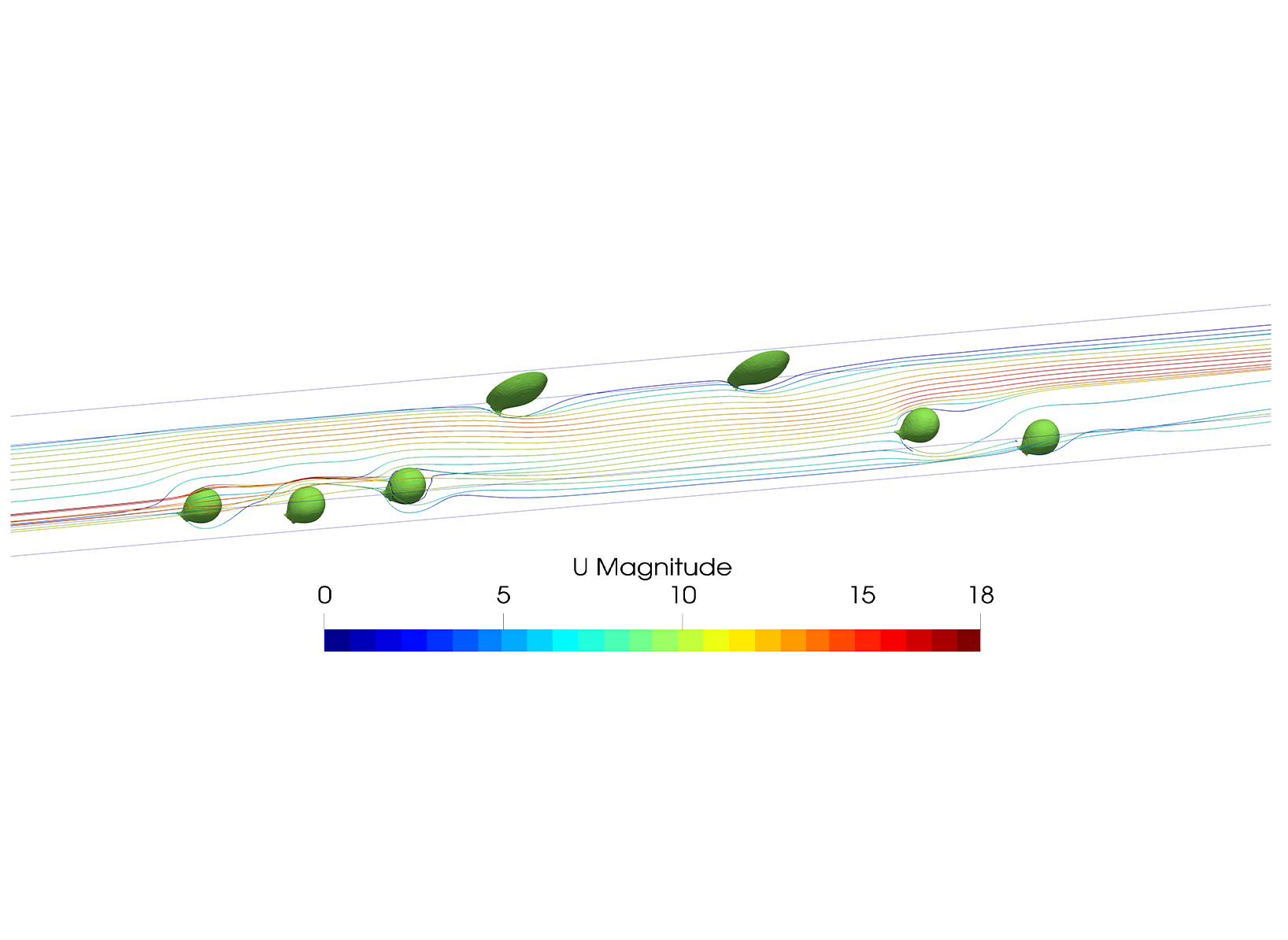 Simulations of gas flow around water droplets in the flowfield of a fuel cell. The surface of the droplets and the flow velocity are depicted.
 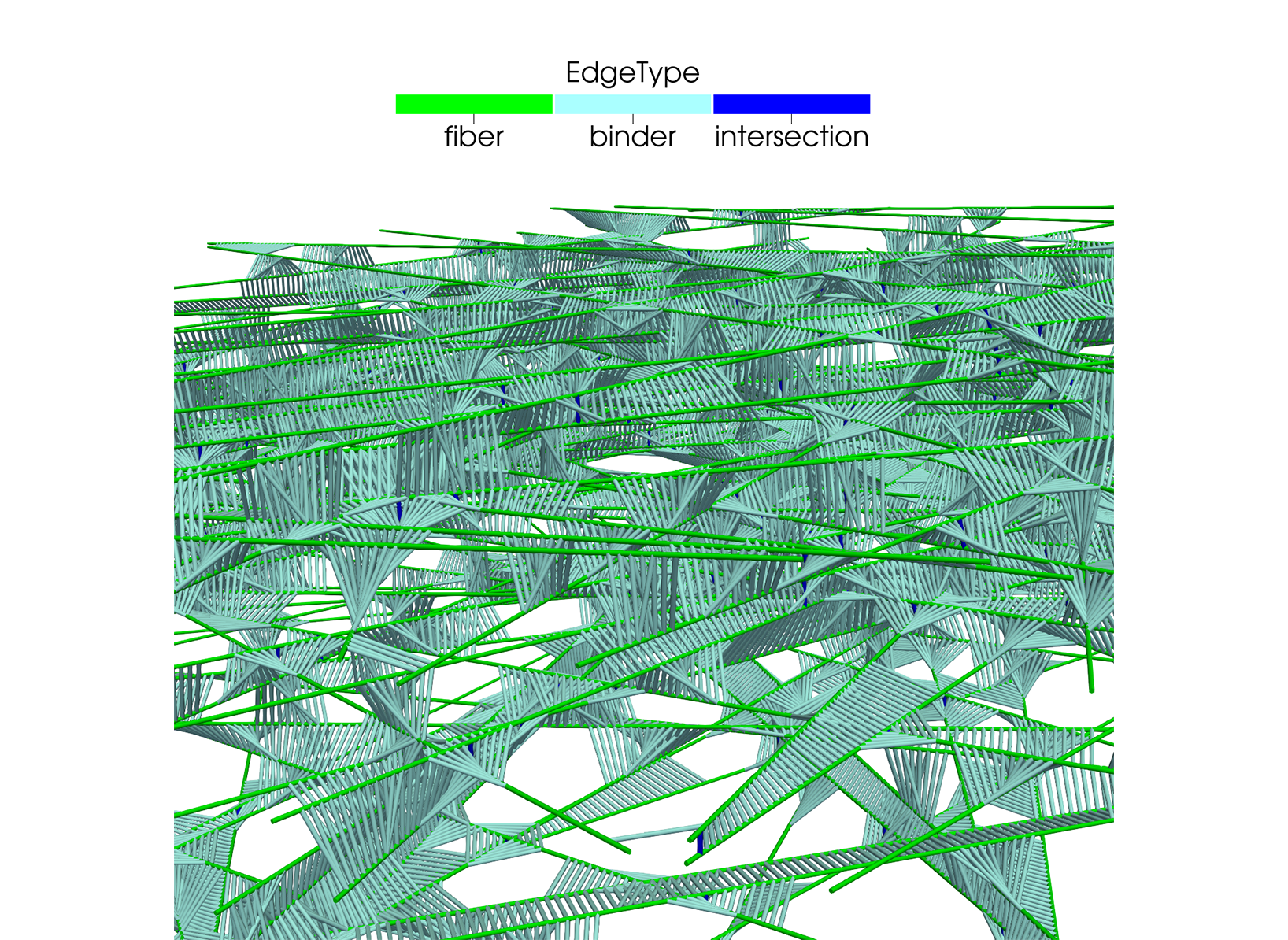 Graph representation of the Network used for the ML for fibrous gas diffusion layers. Each node is connected to its neighbours by edges corresponding to different connections in the real sample.
 The integration of renewable energy sources into modern energy systems requires efficient methods for energy conversion and storage. Electrolyzers and fuel cells play a central role in this transition, with Proton Exchange Membrane (PEM) technologies among the most promising options. The project p0022420 “H2-Sim” focused on improving the understanding of transport mechanisms inside PEM cells, particularly within the Gas Diffusion Layer and the Microporous Layer (MPL). These components are critical because they enable the simultaneous transport of gas, water, and electrical current, thereby strongly influencing overall cell performance. To address the complexity of these processes, the project employed two complementary approaches: high-fidelity CFD simulations and advanced machine learning methods. The numerical simulations were used to resolve multiphase transport phenomena in porous structures at the micrometer scale, while machine learning was explored as a means to accelerate predictions and enhance conventional modeling.
Project Details
Project term
November 13, 2024–November 12, 2025
Affiliations
RWTH Aachen University
Institute
IET-4
Principal Investigator
Methods
For the electrochemical simulations two-phase flow calculations were performed on droplet merging and separation in PEM fuel cell flow channels. Different outlet positions and shapes were used to investigate droplet transport. The influence of the microporous layer in the PEFC was investigated by transport simulations based on Nano-CT reconstructions. In the Machine Learning part the use of AI to predict the outcome of numerical simulations was investigated for two use cases. A machine learning model was trained on both simulation and experimental data to predict the permeability of porous structures. As a second use case of ML enhanced simulations, a computationally fast machine learning model to predict the mechanical response of the gas diffusion layer to compressive stress was developed. The complex topology of the fiber structure used in the material made it necessary to use a graph neural network. In the developed model, the connectivity of the nodes resembles the actual microscopic structure of the material.
Results
The CFD simulations of two-phase flow and a droplet force analysis revealed the droplet transport mechanisms in the flow channel. For the microporous layer, the influence of cracks on drainage and water retention was calculated. Here, the impact of the crack shape and size was analyzed and an optimized microporous layer structure was identified. In the Machine Learning part Froning et al. successfully used an AI model to predict permeability of porous structures by training a model on mass transport simulations. If the training data corresponds well with the application data, a valid prediction is possible. For the mechanical behavior, the predicted displacements show sufficient agreement with the true displacements in the linear regime. It was shown that a significant speedup with a factor of 10 – 100 in computational time can be achieved with a small loss in accuracy if the simulation is replaced by a pretrained ML model. However, for nonlinear stress strain relationships, the models accuracy drops significantly.
Discussion
In the H2-Sim project, a solid foundation was established for optimizing the gas diffusion layer and improving overall water and gas transport in PEM fuel cells. Due to the highly heterogeneous microscopic structure of these materials, simulations at the microscale are essential for accurately resolving the relevant transport and mechanical phenomena. In this work, water transport was analyzed using conventional CFD-based simulations in OpenFOAM. These simulations enabled a detailed investigation of droplet dynamics in flow channels as well as the effect of cracks and pore structure in the microporous layer. Based on these results, an optimized structure with reduced mass transport resistance was identified, demonstrating the value of high-resolution numerical modeling for guiding material design. In addition to classical simulations, the project showed that modern machine learning techniques can effectively complement and accelerate the analysis of porous fuel-cell materials. ML models were successfully applied to predict permeability based on simulation and experimental data, provided that the training data covers the relevant range of structures encountered in practical applications. Likewise, a graph neural network was developed to predict the mechanical response of the fibrous gas diffusion layer under compression. This approach captures the complex topology of the material and provides displacement predictions that are sufficiently accurate in the linear regime, while offering a speedup of one to two orders of magnitude compared to full numerical simulations.
Additional Project Information
DFG classification: 404-01 Energy Process Engineering
Software: OpenFOAM, TensorFlow, OpenFuelcell2
Cluster: CLAIX
Publications
Thesis:
Lukas Ihmer,
Graph Neural Network zur Vorhersage mechanischer Verformungen von Fasern in der Gasdiffusionsschicht von Brennstoffzellen
Master thesis, 2025