Project
Parallel approaches to cosmic-ray transport
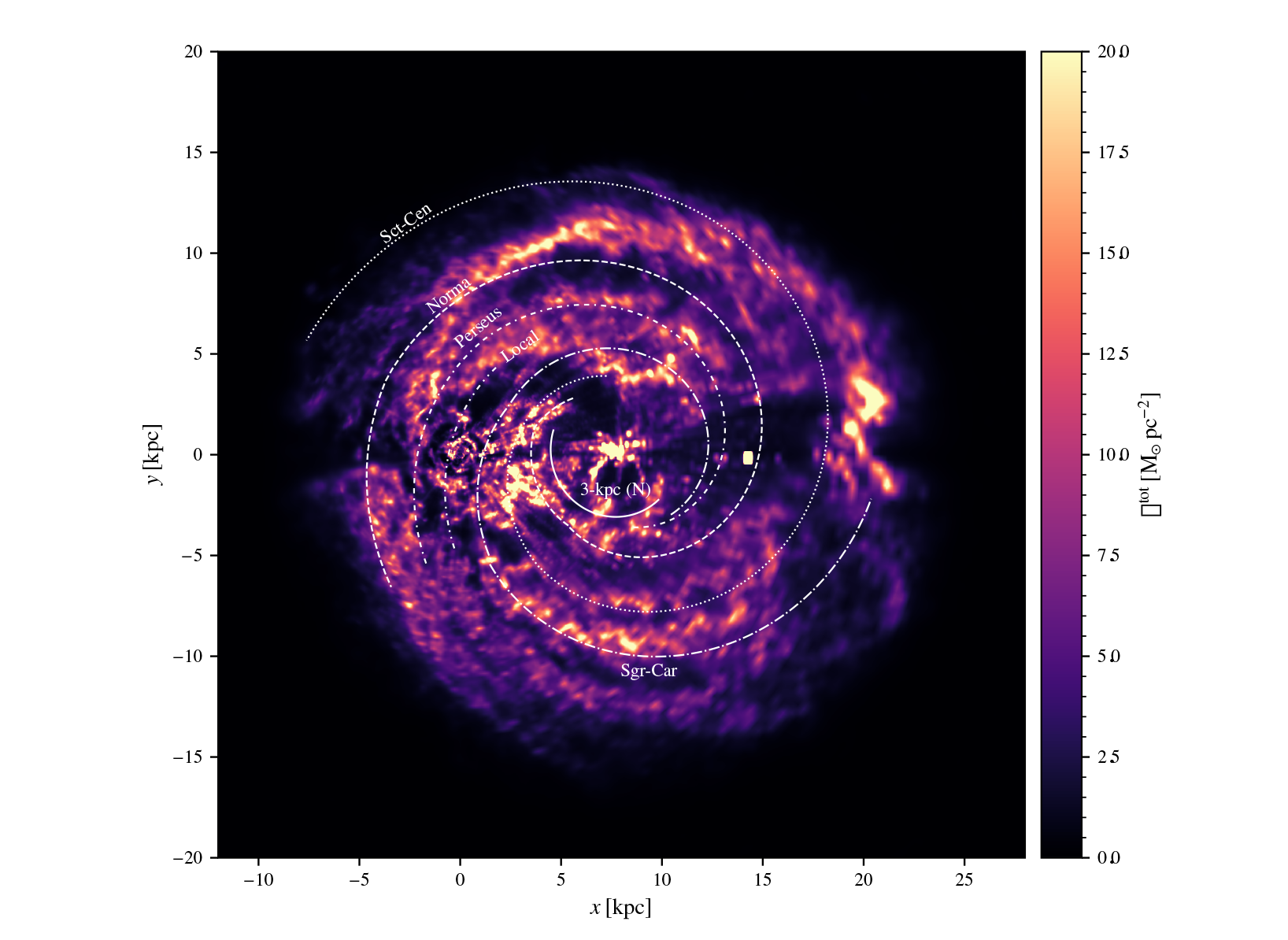 Bird's eye view of the Galactic plane in neutral hydrogen. The solar system is at x=0 kpc, y=0 kpc, the Centre of the Milky Way is at x=8.2kpc, y=0 kpc. Overlaid are the centres of spiral arms.
 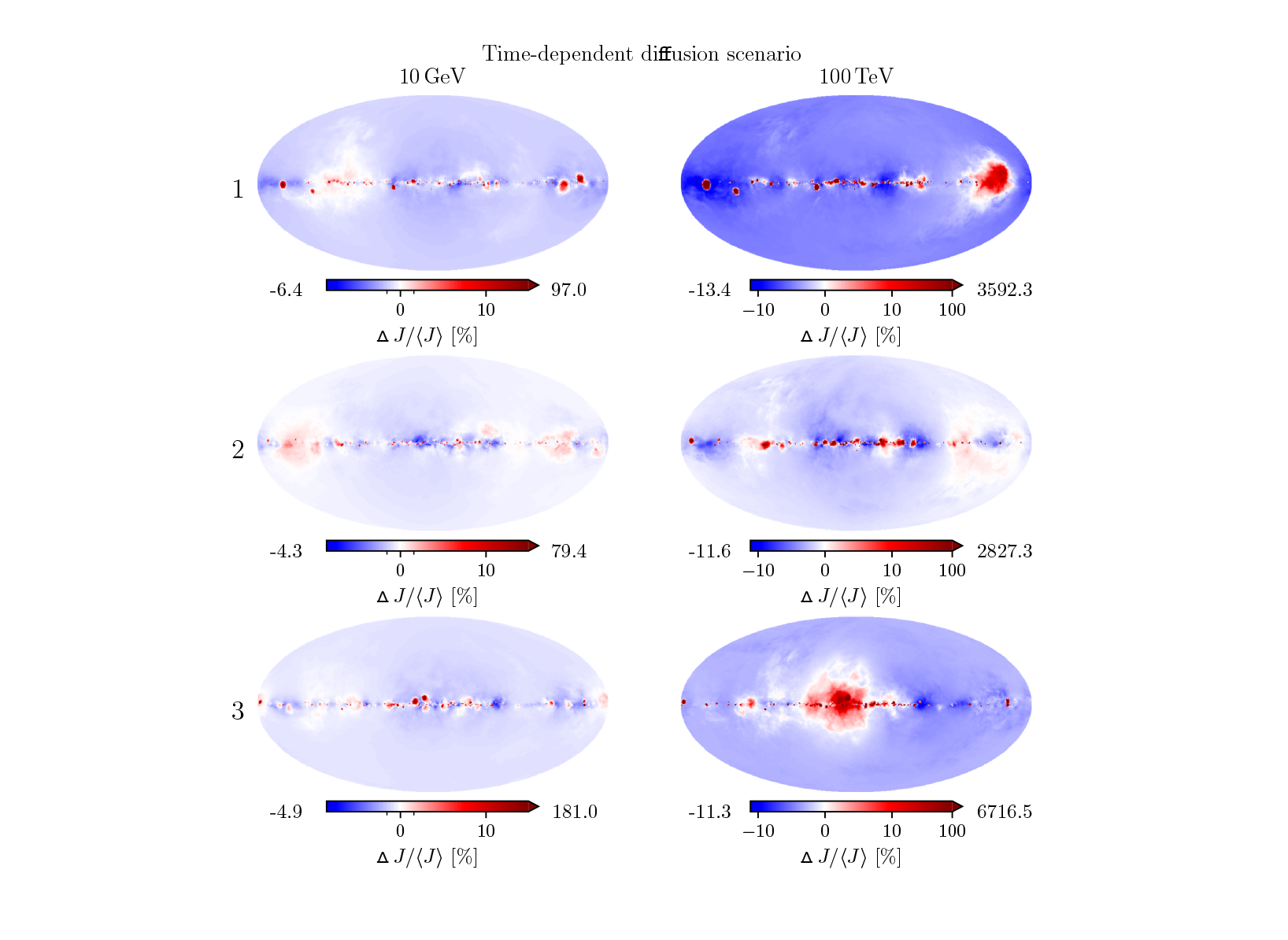 Simulated gamma-ray sky maps. Each line shows a different random realisation, for 10 GeV (left) and 100 TeV (right column). Blue (red) regions have lower (higher) intensities than the average.
 The project had four subprojects:
Stochastic models
The density of Galactic cosmic rays at very high energies can be strongly influenced by the exact positions and ages of their sources. However, these properties cannot be constrained by observations. Thus, the influence of unknown source coordinates must be studied stochastically. The cosmic-ray density can be observed locally by direct measurements and non-locally through diffuse gamma-ray and neutrino emissions produced by cosmic rays interacting with the interstellar medium in other parts of the Galaxy.
3D maps of Galactic gas
Determining the distance to both diffuse gas and compact clouds in our Galaxy is difficult because, except for very few individual objects, there is no direct distance measurement available. However, since the gas fills almost the entire volume of the Milky Way, its distribution is key for understanding the structure and dynamics that govern the history and future of our Galaxy. The ggift project has demonstrated a novel framework for mapping out neutral hydrogen gas in the Milky Way in three dimensions.
The local bubble
Before detection at Earth, cosmic rays from the Galaxy will have to traverse the so-called Local Bubble, a region that is underdense in gas and that the solar system is embedded in. The Local Bubble is a few hundred light years across and the Galactic magnetic field is likely aligned with the bubble wall. This configuration has the potential of inhibiting the intensity of cosmic rays observed on Earth. Specifically, this could explain why the cosmic ray intensity elsewhere in the Galaxy is higher, as inferred from the observation of ionisation in molecular clouds.
Project Details
Project term
April 17, 2024–September 2, 2025
Affiliations
RWTH Aachen University
Institute
Institute for Theoretical Particle Physics and Cosmology
Principal Investigator
Methods
Stochastic models
We studied the influence of cosmic-ray source coordinates through extensive Monte Carlo simulations. For this, we calculated the cosmic-ray density throughout a model Galaxy by adding the contributions from millions of individual sources for each realisation of source positions and ages. This problem is computationally expensive, but efficiently parallelisable. We used array programming with Python’s NumPy package and accelerated GPU computation with Jax.
3D maps of Galactic gas
The ggift project employs a modern Bayesian inference framework for performing a probabilistic reconstruction. This means reconstructing the posterior probability of the gas density, given the measured spectroscopic radio data. For doing so, we develop a forward model that can forecast synthetic measurement data for any possible density configuration. We then apply the geoVI-algorithm, performing the probabilistic inversion.
The local bubble
For the simulation of the Local Bubble, we ran magneto-hydrodynamic simulations. First, the background was prepared by turbulently driving a model of the Galactic disk. Next, a number of supernova explosions, compatible with the origin of the Local Bubble were simulated in the turbulent background. The magnetic field configuration was fixed in the last step and the trajectories of high-energy cosmic rays were computed. The density of cosmic rays in the interior of the Local Bubble was recorded as a function of time.
Results
Stochastic models
Large sample sizes of millions of realisations of cosmic-ray densities throughout our model Galaxy allowed us to perform a detailed statistical analysis of variations in both locally measurable cosmic-ray fluxes and diffuse emissions. The high statistical power of our simulations made it possible to test theoretical predictions and improve estimates of the variations linked to the uncertainty of source coordinates. This is especially valuable in the light of upcoming high-precision measurements.
3D maps of Galactic gas
The main result of the ggift project is a set of samples, each containing one possible density configuration that can fully explain the actual measurement data. The variance that the samples exhibit reflects our uncertainty about the true gas distribution. Main sources for this are measurement uncertainties inherent to the data, regions with no data coverage, and inherent model degeneracies (that is multiple configurations that would lead to exactly the same measurement data).
The local bubble
We have found that during expansion of the Local Bubble the magnetic field present in the Galactic disk does get draped around the bubble. However, there are small regions on either end of the bubble where the magnetic field density is very small which allows for cosmic rays to enter the bubble. The density of cosmic rays inside the bubble is therefore suppressed temporarily, but does not explain why the density at Earth would be lower than elsewhere for extended periods of time.
Discussion
Stochastic models
Our results sketch a new way for looking for individual sources of cosmic rays. They can explain some of the surprising findings of gamma-ray experiments like LHAASO. At the least, the stochastic fluctuations are to be considered as an additional source of uncertainty in modelling of diffuse emission.
3D maps of Galactic gas
The improvements of the ggift model developed in this project substantially improve our ability to infer the three-dimensional gas structure in the Milky Way. By iteratively refining our forward model, we improve our description of the underlying physics, thereby extracting more and more accurate information from the data. These reconstructions are already now and will be used in the future for studies about other components of the Milky Way, such as stars, magnetic fields, or dark matter.
The local bubble
We have falsified the original hypothesis that the density of cosmic rays can be suppressed by the Local Bubble. However, the bubble could lead to subtle patterns in the arrival directions of cosmic rays on Earth which will need to be studied in the future.
Additional Project Information
DFG classification: 311 Astrophysics and Astronomy
Software: Greens, Gift, Testparticle
Cluster: CLAIX
Publications
Investigating the CREDIT History of Supernova Remnants as Cosmic-Ray Sources,
https://dx.doi.org/10.3847/2041-8213/adaea8, Februrary 2025
Laurin Söding, Gordian Edenhofer, Torsten A. Enßlin, Philipp Frank, Ralf Kissmann, Vo Hong Minh Phan, Andrés Ramírez, Hanieh Zandinejad, Philipp Mertsch,
Spatially coherent 3D distributions of HI and CO in the Milky Way,
https://dx.doi.org/10.1051/0004-6361/202451361, January 2025
Anton Stall, Philipp Mertsch,
Stochastic modelling of cosmic-ray sources for Galactic diffuse emissions,
https://dx.doi.org/10.48550/arXiv.2509.06857, September 2025
Thesis:
Chun Khai Loo,
Cosmic Rays’ Energy-Dependent Injection Time (CREDIT),
Master thesis, 2025