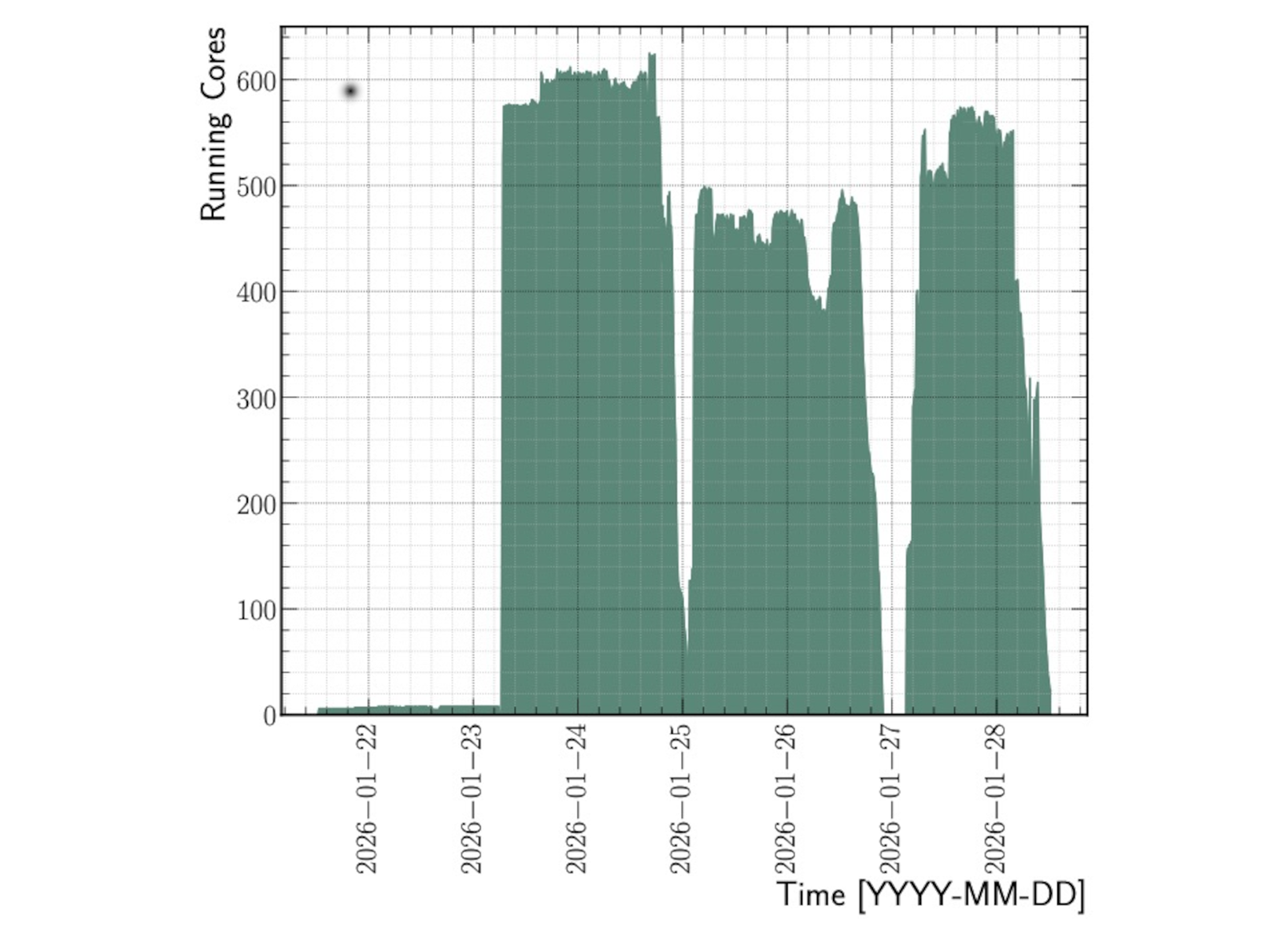
 The histogram shows running cores on CLAIX during a few day period in January 2025. Our automatic job submission targets to run about 500 jobs constantly in case workflows are available.
 There is a general formal agreement between the German High Energy Physics (HEP) community and NHR organisation that national computing resources can be integrated long-term to provide the CMS High Energy Physics (HEP) experiment at CERN (Geneva) with CPUs. Further NHR sites which contribute to this agreement are EMMY at Göttingen and HOREKA at Karlsruhe. The NHR resources, together with resources of about 50 other sites worldwide, are used to run experiment workflows to reconstruct and simulate data and to submit individual users’s data analyses. Three Aachen physics institute participate in this HEP experiment with about 50 users (scientists and students).
Project Details
Project term
April 1, 2025–March 31, 2026
Affiliations
RWTH Aachen University
Institute
III. Physikalisches Institut A
Principal Investigator
Methods
We use a workflow tool (COBALD & TARDIS) developed from our CMS colleagues at KIT Karlsruhe to automatically submit and control our workflows running at CLAIX. C&T, which is integrated transparently for the CMS operation team and users, aims to run a rather constant load of 500 cores (if workflows are available). The running pilot jobs (48h) receive consequent experiment and user payloads controlled by the central CMS computing team. The CLAIX worker nodes can directly access input and output data from the (still existing) Aachen Grid CMS Tier-2 center and other storage centers worldwide via the existing high-bandwidth Aachen and DFN network.
Results
It was possible to use CLAIX rather efficient most of the time by the CMS experiment’s central operations team and individual analysis users. Together with about 50 other computing sites numerous CMS publications and thesis have been produced or are in preparation worldwide. It is not possible to associate dedicated publications or theses to individual computing sites because the computing resources of all contributing sites are distributed dynamically. Presently the 500 cores are still a small contribution to the CMS computing, but it is planned to increase the NHR contribution (together with HOREKA) year by year since the dedicated Aachen Grid computing resource which will not be renewed are fading out.
Discussion
Integrating the CLAIX CPUs into the CMS experiment’s workflows was a big success and it is planned to be continued with more and more resources in the forthcoming years. The major migration of the Linux operation system Rocky version 8 to 9 was transparent for us Since we rely on the availability to have “a container in a container” to run the specific experiment’s software we need user namespaces. Sometimes CLAIX disabled user namespace because of security aspects, this prevented us to use the cluster for more than 2-3 weeks. To establish a fast direct personal communication line between the CLAIX operation team and the CMS computing experts in Aachen would be a benefit.
Additional Project Information
DFG classification: 309-01 Nuclear and Elementary Particle Physics, Quantum Mechanics, Relativity, Fields
Cluster: CLAIX
Publications
CMS Collaboration,
Measurements of inclusive and differential Higgs boson production cross sections at TeV in the H → γγ decay channel,
https://dx.doi.org/10.1007/JHEP09(2025)070, September 2025
CMS Collaboration,
A search for HH to bb gamma gamma production in proton-proton collisions at sqrt(s) = 13.6 TeV with a partial CMS Run 3 dataset,
https://cds.cern.ch/record/2945062, 2025