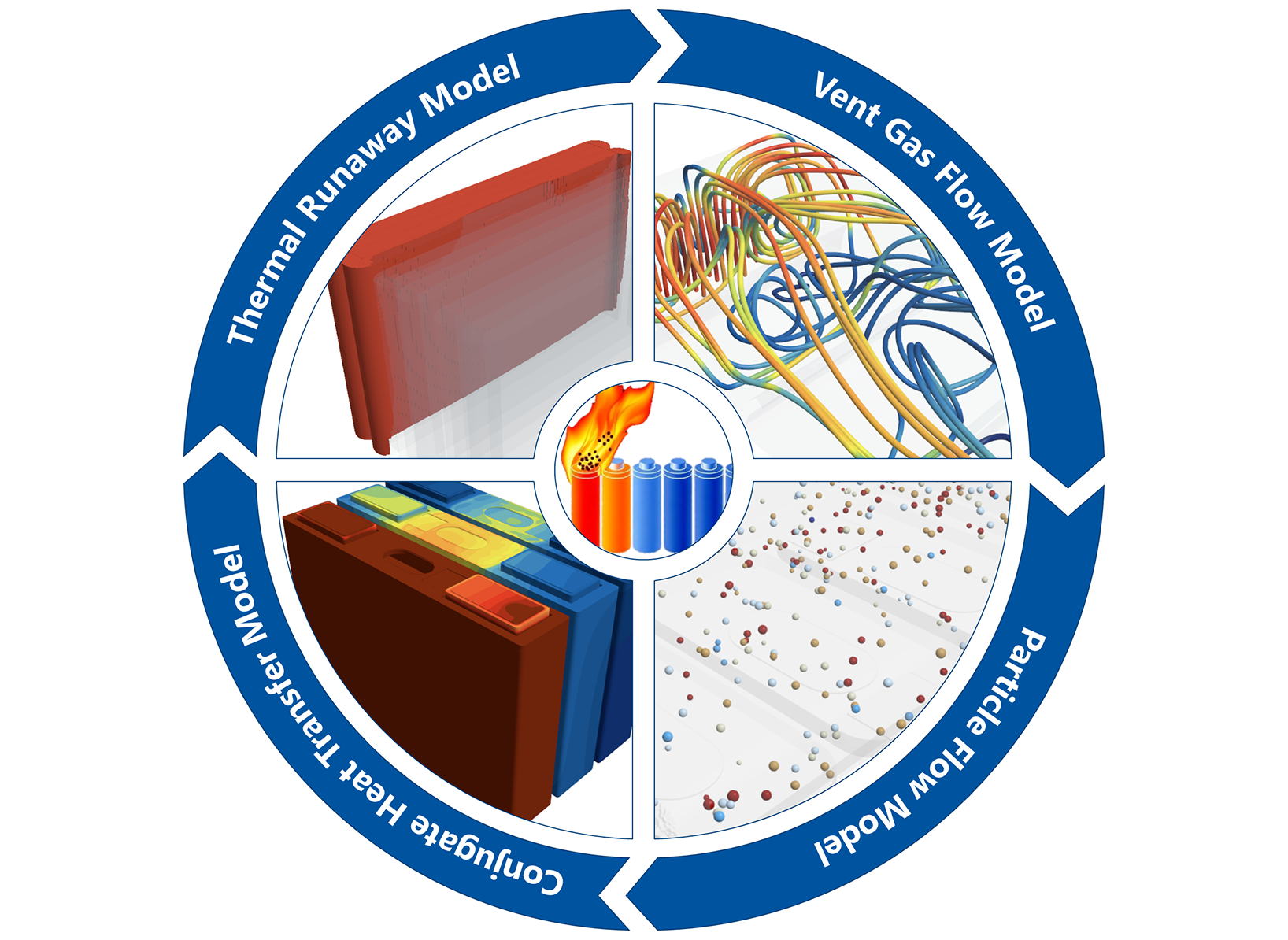
 Schematic overview of the thermal runaway and propagation methodology applied in this project
 Safety concerns regarding battery fires are one of the major obstacles to widespread customer acceptance of electric vehicles. The main causes of fires in lithium-ion battery systems are thermal runaway (TR) and thermal propagation (TP). TR is an exothermic chain reaction within a battery cell that leads to high temperatures and the emission of flammable gases and particles. TP describes the spread of TR events from one cell to neighboring cells. Various regulations have been introduced to establish TR/TP-related safety standards, particularly in the automotive and aerospace industries. In order to design battery systems that comply with these regulations, effective methods must be developed to inform design decisions as early as possible in the development process. Since large-scale testing is costly and prototypes are often unavailable in time, simulation-based methods are a promising solution. TR and TP involve complex multiphysics phenomena, such as reaction kinetics, fluid flow, particle flow, and heat transfer, in high fidelity geometries. Due to the large computational domains and complex physics involved, high-performance computing (HPC) is essential for achieving reasonable turnaround times in iterative design processes.
Project Details
Project term
November 11, 2024–December 8, 2025
Affiliations
RWTH Aachen University
Institute
Chair of Thermodynamics of Mobile Energy Conversion Systems
Principal Investigator
Methods
The methodology to simulate TR and TP in a multiphysics context was developed using the finite volume method in the commercial software Star-CCM+ in conjunction with real-world design tasks. It can be divided into four submodels: the TR model of the battery cell, the vent gas flow model, the particle flow model, and the conjugate heat transfer (CHT) model. The TR model incorporates the battery cell’s detailed 3D geometry with a homogeneous active material stack approach. Chemical reactions are approximated using two Arrhenius-type equivalent reactions, and cell mass loss is coupled with the reaction rate. Kinetic parameters are fitted in a 1D Simulink model based on accelerated rate calorimetry experiments. Then, an autoclave TR test setup is simulated in 3D with the tuned kinetic parameters for validation. The vent gas flow is modeled using the Reynolds-averaged Navier-Stokes (RANS) equations with a two-component gas (air and vent gas). The vent particle flow is simulated using a Lagrangian multiphase (LMP) approach and the parcel method. Multiple particle forces, as well as particle energy and radiation, are considered to accurately simulate trajectories and heat transfer. Detailed models of particle-wall interactions are used based on impact velocity and angle. Where available, measured high-fidelity input data on particles, such as particle size and shape distributions, are used. To predict TP, a CHT model for the investigated geometry is developed. This model considers multipart solid heat transfer and heat exchange with the two-phase flow.
Results
Depending on the models applied and the geometry under investigation, the required computational resources for this project range from ~500 core-hours for a TR model validation run to ~100,000 core-hours for a fully coupled TP simulation at the battery module level. This makes HPC resources indispensable. The TR model can accurately predict the thermal behavior of the cell regarding measured temperature profiles, TR onset, and reaction duration. It can be observed that TR behavior changes depending on the boundary conditions, for example, with different overheating rates. The drag force is the primary force affecting particle trajectories. Accurately considering particle morphology (size and shape distribution) significantly impacts particle motion. Multiple numerical studies with different levels of detail (from steady state to transient and from CFD to CFD LMP to CHT LMP) support the design of an exhaust gas management system (EGMS) on the battery module level. The EGMS can successfully prevent the ignition of vent gases outside the module. At the battery module level, the models are fully coupled, and a TP experiment is re-simulated for validation. Several characteristics of the experiment, such as cell TR temperatures, reaction progress, gas temperatures, and pressure drop, can be predicted with reasonable accuracy.
Discussion
The developed methodology is a useful tool to virtually assess battery designs in terms of TR and TP safety. Thanks to HPC resources, it is possible to iterate designs and draw conclusions within a feasible timeframe. However, some challenges were observed during the first half of this compute project. Due to the strong coupling between models, uncertainty propagation arises. For instance, the thermal conductivity of the cell’s active material influences the rate at which the TR reaction zone propagates within the cell. Consequently, the vent gas and particle mass flows are affected, which influences the particle flow behavior and the predicted particle filtering efficiency, among other things. Furthermore, small errors in cell temperature prediction can lead to vastly different propagation behavior. For instance, an error of 15 K (228°C versus 243°C) in the predicted neighboring cell hot side temperature resulted in an incorrect prediction of no TP due to the exponential nature of the TR reaction kinetics. Thus, special care must be taken when interpreting the results, and additional safety margins should be considered when judging design feasibility. A well-calibrated TR model alone is insufficient for accurate predictions. All relevant input parameters, such as material properties or particle morphology, must be accurate and detailed to reduce uncertainties in the prediction. In the second half of this compute project, the developed approach will be scaled up to battery system level for automotive and aeronautic battery systems. Since one key requirement is predicting fire outside the battery system, a simplified 3D ignition prediction model will be incorporated into the simulation framework. Additionally, an uncertainty study of the key parameters will be conducted to understand the reliability and limitations of the methodology.
Additional Project Information
DFG classification: 404 Fluid Mechanics, Technical Thermodynamics and Thermal Energy Engineering
Software: Star-CCM+
Cluster: CLAIX