Project
Influence of Combustor Unsteadiness on Hot Gas Mi- gration through a High Pressure Turbine Stage
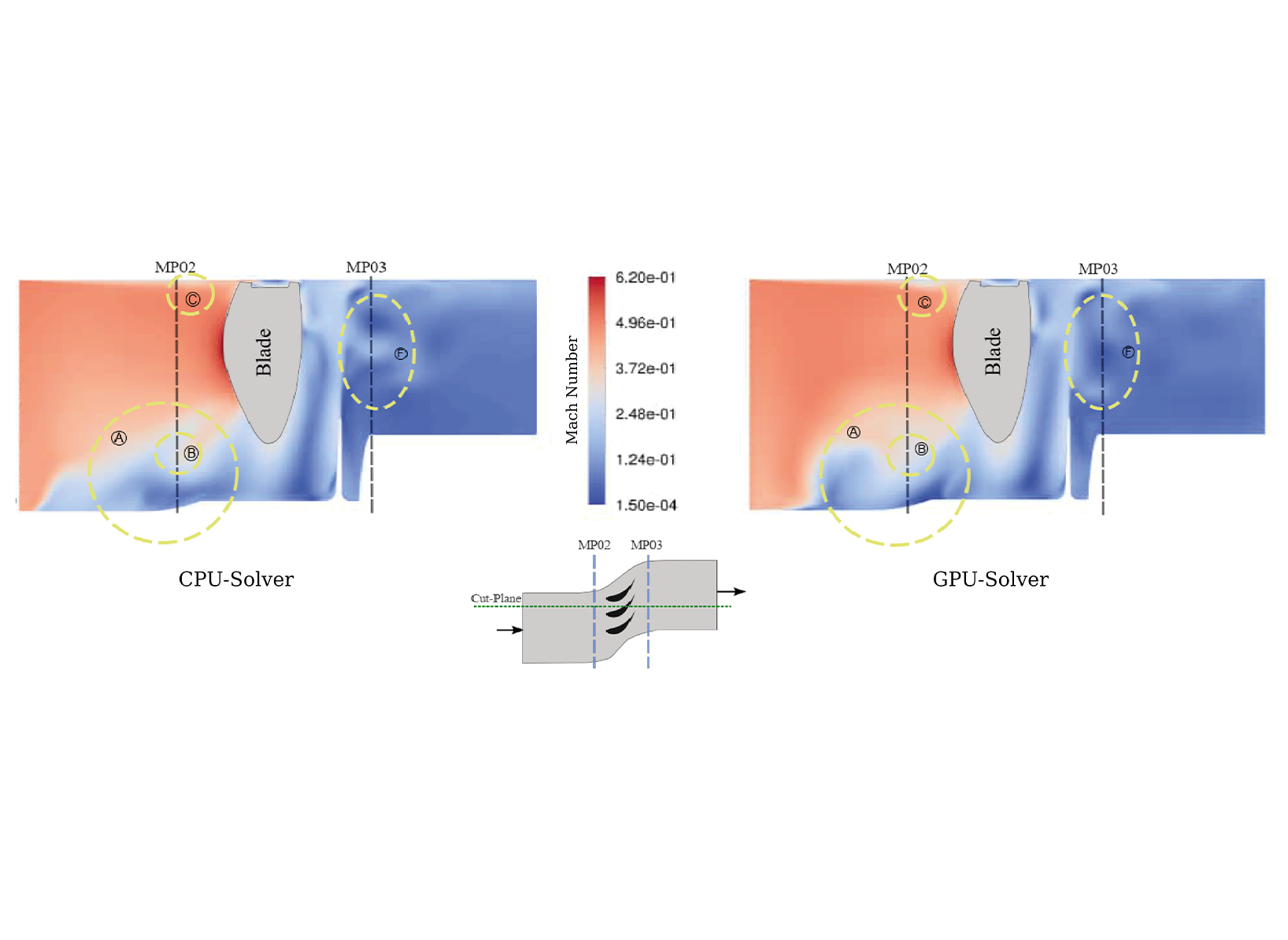 Mach Number distribution within a rotor passage for a CPU based CFD solver (left) and a GPU based CFD solver (right)
 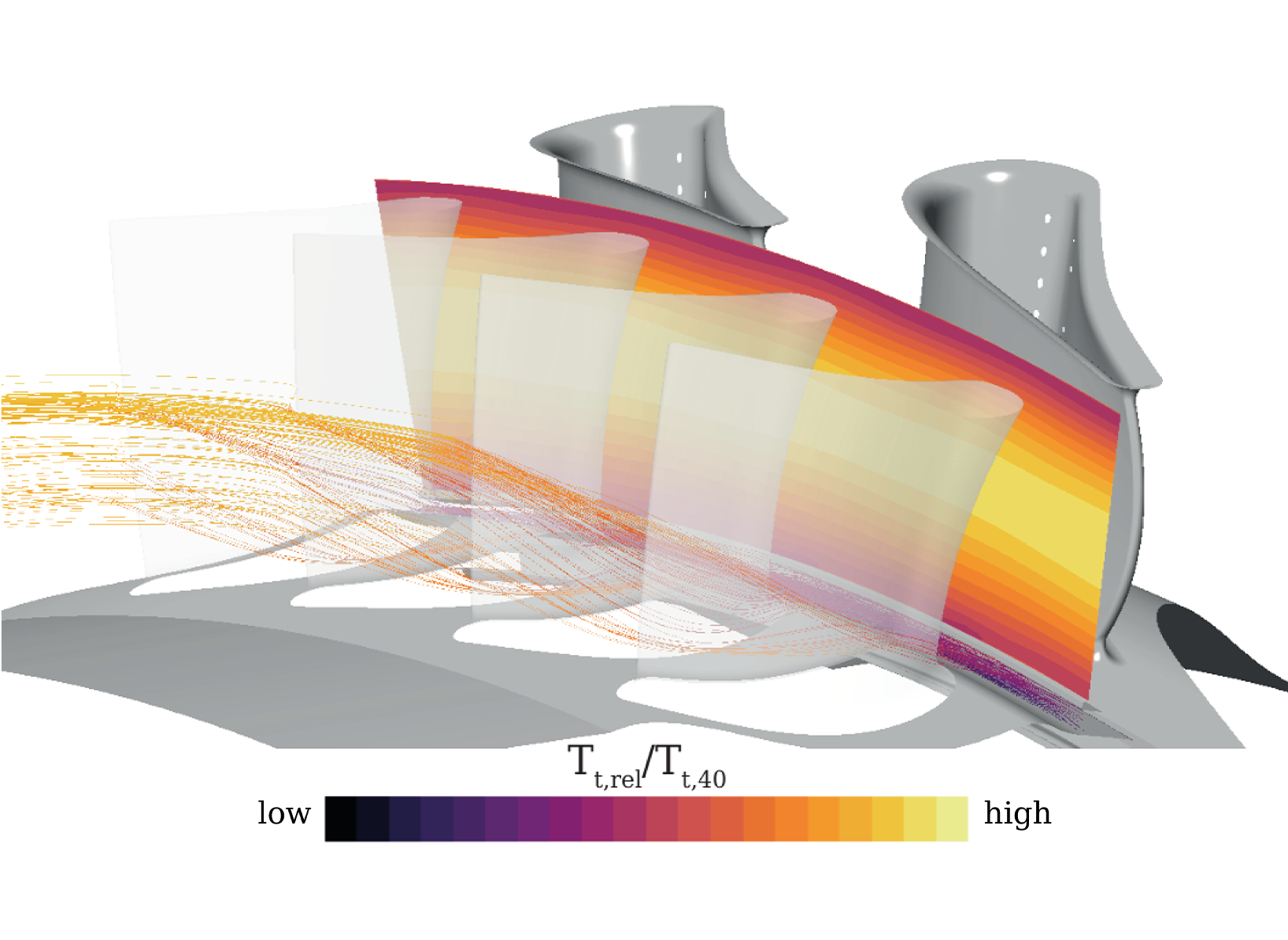 Circumferentially averaged rotor inlet temperature and streamlines, visualizing the rim seal flow
 Combustor unsteadiness is a driving factor for thermal mixing within high-pressure turbines. To capture these effects, the combustor and turbine must be considered together in an integrated simulation. However, this introduces significant challenges regarding numerical modeling. Consequently, combustors and high-pressure turbines are typically simulated separately. To account for the effects of combustor unsteadiness, an unsteady one-way coupling method was developed to transfer time-resolved information from combustor simulations to stand-alone turbine simulations. The Proper Orthogonal Decomposition and Fourier Series (PODFS) method is used to create an unsteady inlet boundary condition from a combustor Large Eddy Simulation (LES) for stand-alone turbine simulations. In this project, the effect of combustor unsteadiness on the aerothermal load of a high-pressure turbine rotor was investigated. Additionally, new GPU-based CFD solvers were evaluated. GPU-accelerated CFD simulations promise faster execution times for even finer resolved meshes. This opens new possibilities regarding the scale-resolving simulations of highly complex flows, such as those present in turbomachinery. Ultimately, the emerging capabilities of these GPU-accelerated CFD solvers were tested for complex turbomachinery applications.
Project Details
Project term
April 16, 2025–May 15, 2026
Affiliations
TU Darmstadt
Institute
Gasturbinen und Luftfahrtantriebe
Principal Investigator
Methods
The PODFS method allows for the determination of the spatial and temporal modes of the combustor exit flow. These modes are ranked by their energy content and then reduced to the most dominant modes, which describe the relevant characteristics of the flow. This reduced data set is then used as an unsteady inlet boundary condition for stand-alone turbine simulations. The instantaneous flow field information is reconstructed from the data set. Since the temporal modes are represented as a Fourier series, the reconstructed flow field data is independent of the time step of the original combustor data set. This allows for “best practice” simulations for the combustor and the turbine stage without the compromises required when simulating both components in an integrated setup. For the GPU-based simulations, the commercial CFD-GPU solver from Ansys is used to investigate its capabilities for turbomachinery applications. The focus is set on the practicability of the tool and its economic benefit in comparison to CPU-based CFD solvers.
Results
Results show that combustor unsteadiness has a major impact on the temperature traverse at the stator exit of the high-pressure turbine stage. Higher temperatures are observed in the end-wall regions, significantly affecting the lifetime expectancy of the turbine due to the higher thermal load in the hub region of the rotor. The stage efficiency of the turbine decreases when combustor unsteadiness is considered. The mixing processes in the rotor are mainly driven by the unsteadiness created within the rotor itself; combustor unsteadiness plays a minor role in these specific mixing processes. A more relevant aspect is the choice of the turbulence model, as scale-resolving simulations show a different prediction of the tip vortex region. Regarding the GPU-accelerated CFD simulations, the current capabilities of the solver are not yet sufficient to handle complex, turbomachinery-specific problems. Specifically, the handling of stator-rotor interfaces for non-full-annular setups is currently inadequate. Therefore, the simulation setup was simplified to investigate the economic efficiency of the GPU solver. This study showed a twofold speed-up and a cost reduction by a factor of seven compared to the CPU solver.
Discussion
The results demonstrate that combustor unsteadiness plays a crucial role in thermal mixing within the stator. Although the motion of the rotor itself is the primary driver for mixing in the rotor stage, combustor-induced unsteadiness still impacts cooling demands by increasing end-wall temperatures significantly. The redistribution of temperature at the stator exit also influences interactions with purge and leakage flows, such as the rim seal flow. In combination with scale-resolving turbulence models, a deeper penetration of hot gas into the rim seal cavity is expected, leading to stronger heating of the rim seal flow and increasing the thermal load of the rotor.
The current state of the Ansys GPU-accelerated solver primarily supports full-annular domains. However, support for periodic sector-wise simulations (e.g., 30° sectors) is highly desirable. Currently, 360° simulations are often computationally excessive, whereas a specific sector of interest would suffice for most analyses. Implementing periodicity would allow researchers to leverage the high throughput of GPUs to significantly increase the element count within a single sector. This would enable the resolution of much smaller flow scales, facilitating a transition from hybrid RANS/LES models to full Large Eddy Simulations (LES) for turbines, which is currently computationally prohibitive on CPU-based architectures.
Additional Project Information
DFG classification: 404 Fluid Mechanics, Technical Thermodynamics and Thermal Energy Engineering
Software: ANSYS
Cluster: CLAIX