Project
Implicit Large Eddy Simulations in Compressor Cascades Towards Validation of Computational Standards
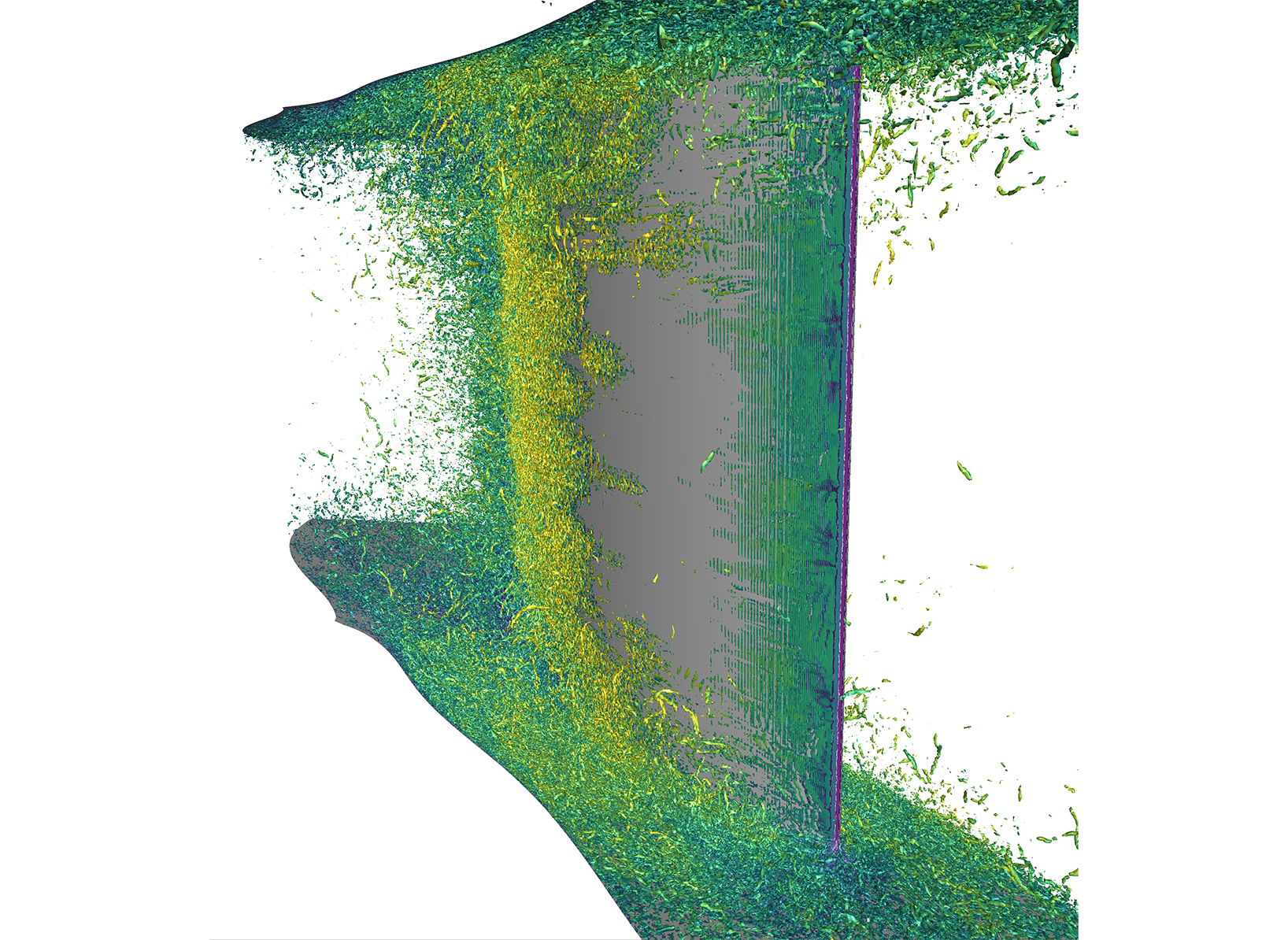 Separation near the leading edge, formation of turbulent spots, subsequent boundary-layer transition and complex vortex structures developing near the endwalls
 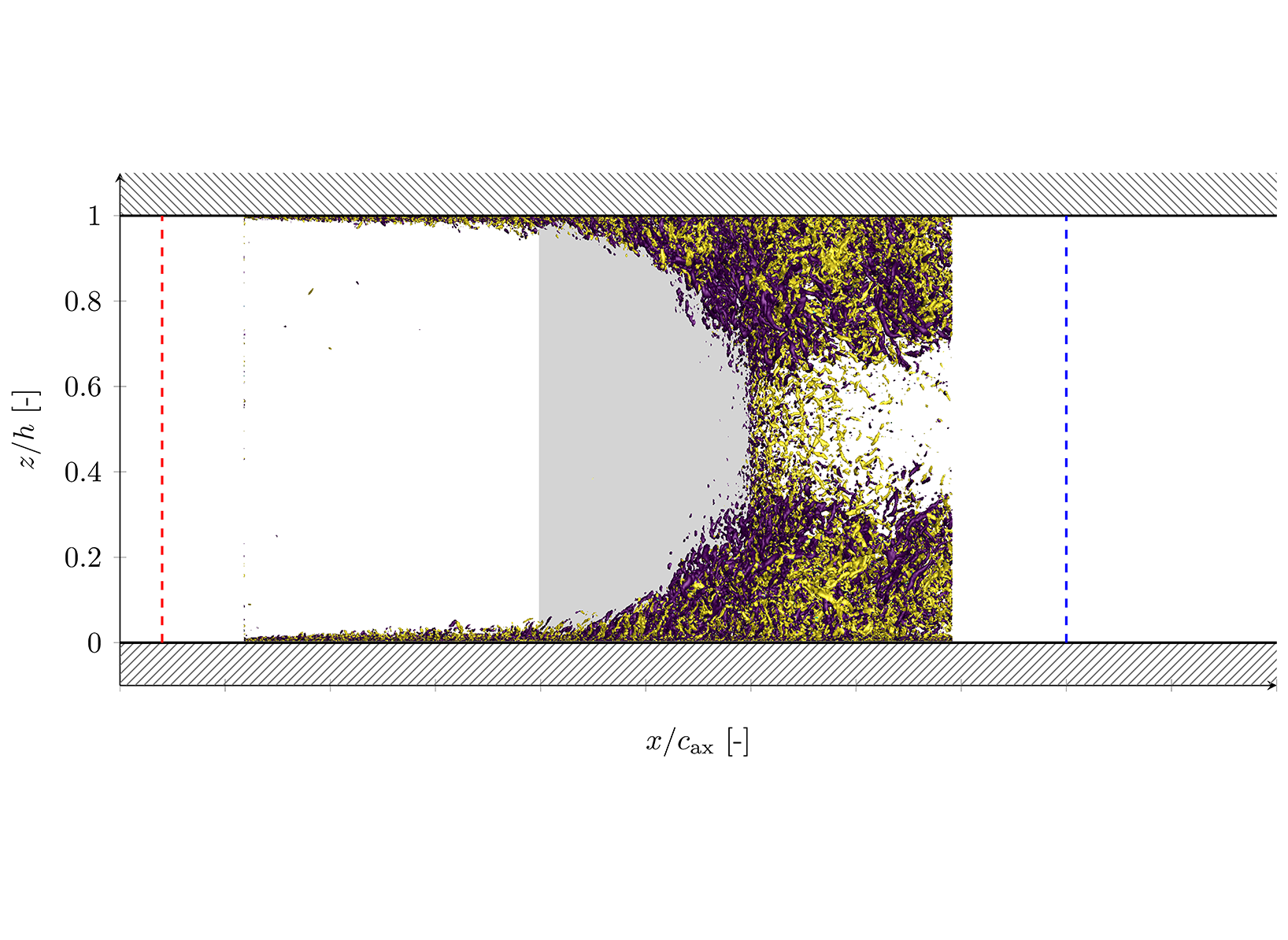 Resolved unsteady flow features
 In turbomachinery flows, regions such as wakes, near-wall layers, separation zones, and tip-clearance vortices are characterized by highly anisotropic turbulent eddies. Reynolds-averaged Navier–Stokes (RANS) models, which have traditionally served as the industry standard in the design process of turbomachines, often struggle to represent these complex turbulent structures accurately, resulting in significant errors in predicted flow behavior. Advances in computational power, however, have made Large Eddy Simulation (LES) an increasingly viable alternative for turbomachinery applications, offering the potential for substantially improved turbulence resolution and predictive capability.
Despite its promise, the application of LES to turbomachinery remains challenging, particularly with respect to mesh generation, boundary condition specification, and subgrid-scale modeling. Consequently, there is a growing need to establish best practices for LES in this context, including guidelines for grid resolution, subgrid-scale model selection, and the configuration of high-order numerical methods such as the Discontinuous Galerkin (DG) approach. The strong sensitivity of LES results to inflow boundary conditions further highlights the importance of developing robust and reliable inflow turbulence generation techniques.
In this computating time project, we seek to address these challenges by performing implicit LES of a subsonic compressor cascade using a high-order DG solver. The numerical results are validated with complementary experimental data obtained in our high-speed linear cascade wind tunnel. The primary objective of this study is to determine the spatial resolution requirements across different flow regions, with particular emphasis on critical secondary-flow structures. This work builds on prior efforts to verify the numerical methodology and to establish best practices for high-order DG simulations of turbomachinery cascades. By advancing LES toward a reliable virtual test bench, this research aims to reduce reliance on extensive experimental testing during turbomachinery blade design, thereby accelerating technology development cycles in both the power generation and aviation industries.
Project Details
Project term
January 1, 2025–December 1, 2025
Affiliations
RWTH Aachen University
Institute
Institute of Jet Propulsion and Turbomachinery
Principal Investigator
Methods
In this computing time project the compressible, non-reacting Navier-Stokes equations are solved with an implicit Large Eddy Simulation (LES) approach within the TRACE solver. TRACE (Turbomachinery Research Aerodynamic Computational Environment) is a Computational Fluid Dynamics (CFD) solver developed jointly by the German Aerospace Center (DLR) and MTU Aero Engines AG. The governing equations are discretized using a nodal Discontinuous Galerkin scheme, specifically the Discontinuous Galerkin Spectral Element Method (DGSEM), which is based on the collocation of interpolation and quadrature nodes. As the numerical dissipation inherent to DGSEM predominantly affects the smallest resolved scales, the method well suited for implicit LES, where numerical dissipation effectively acts as a subgrid-scale model for the under-resolved, nearly isotropic eddies.
In DG methods, all spatial derivative operators are approximated through discrete representations. These methods combine geometric flexibility with local resolution adaptivity and straightforward extension to higher-order accuracy. The spectral element formulation requires a computational mesh composed of hexahedral elements, enabling the use of tensor-product polynomial spaces spanned by Lagrange basis functions. Time integration in TRACE is performed using an explicit third-order Runge–Kutta scheme. Due to the compact stencil of the DG scheme combined with explicit time integration, good parallel scalability is warranted. To ensure realistic inflow conditions, TRACE incorporates a synthetic turbulence generator based on the approach proposed by Shur.
TRACE runs entirely on CPUs, utilizing unstructured multi-block grids for spatial discretization. The parallel execution is implemented using a hybrid approach. At the highest level, MPI parallelization with block splitting distributes the computational load across processes. Additionally, pthreads parallelism is available without block splitting, maintaining the same load balancing.
Results
A precursor simulation of the inlet channel was performed to derive realistic inflow boundary conditions for the compressor cascade LES. Spanwise distributions of stagnation pressure and Reynolds stresses were iteratively adjusted to match available experimental data. Several iterations were required to reproduce turbulent kinetic energy levels and freestream turbulence decay. The final configuration shows good agreement with measurements and provides physically consistent inflow conditions for the full-domain simulations.
Using the validated inflow, full-domain simulations of the compressor cascade were conducted with a high-order DG discretization. A coarse-resolution simulation was first employed to adjust inlet and outlet boundary conditions to match the target operating point in terms of isentropic Mach and Reynolds numbers. After iterative tuning, deviations from the measured operating point were reduced to within measurement uncertainty. The coarse simulation captures key flow features such as suction-side transition, corner separations, and the onset of secondary flows.
A fine-resolution simulation was subsequently prepared and is currently running to obtain statistically converged data for quantitative comparison with experimental results and for an in-depth analysis of secondary loss mechanisms.
TRACE showed good parallel scalability on the CLAIX system using DGSEM. Optimized block splitting reduced runtime by approximately 10 %. At the time of reporting, the allocated CPU hours were used productively to carry out the completed simulations and analyses described in this report.
Discussion
The results highlight the importance of accurately prescribed inflow boundary conditions for high-fidelity LES of compressor cascades. While coarse grids are sufficient for operating-point matching and qualitative assessment, high-resolution LES is required for a reliable quantitative evaluation of losses and turbulence, particularly near the endwalls.
Due to the high computational cost of implicit LES and ongoing numerical developments within TRACE, a project extension was requested and approved, ensuring completion and thorough analysis of the final simulations.
In parallel, TRACE was further developed to support non-conforming meshes with hanging nodes, improving meshing flexibility and computational efficiency for future LES studies. Overall, the project contributes to establishing implicit LES with high-order DG methods as a reliable virtual test bench for turbomachinery cascade investigations.
Additional Project Information
DFG classification: 404-04 Hydraulic and Turbo Engines and Piston Engines
Software: TRACE
Cluster: CLAIX