Project
Error correction in non-equilibrium many-body quantum spin systems
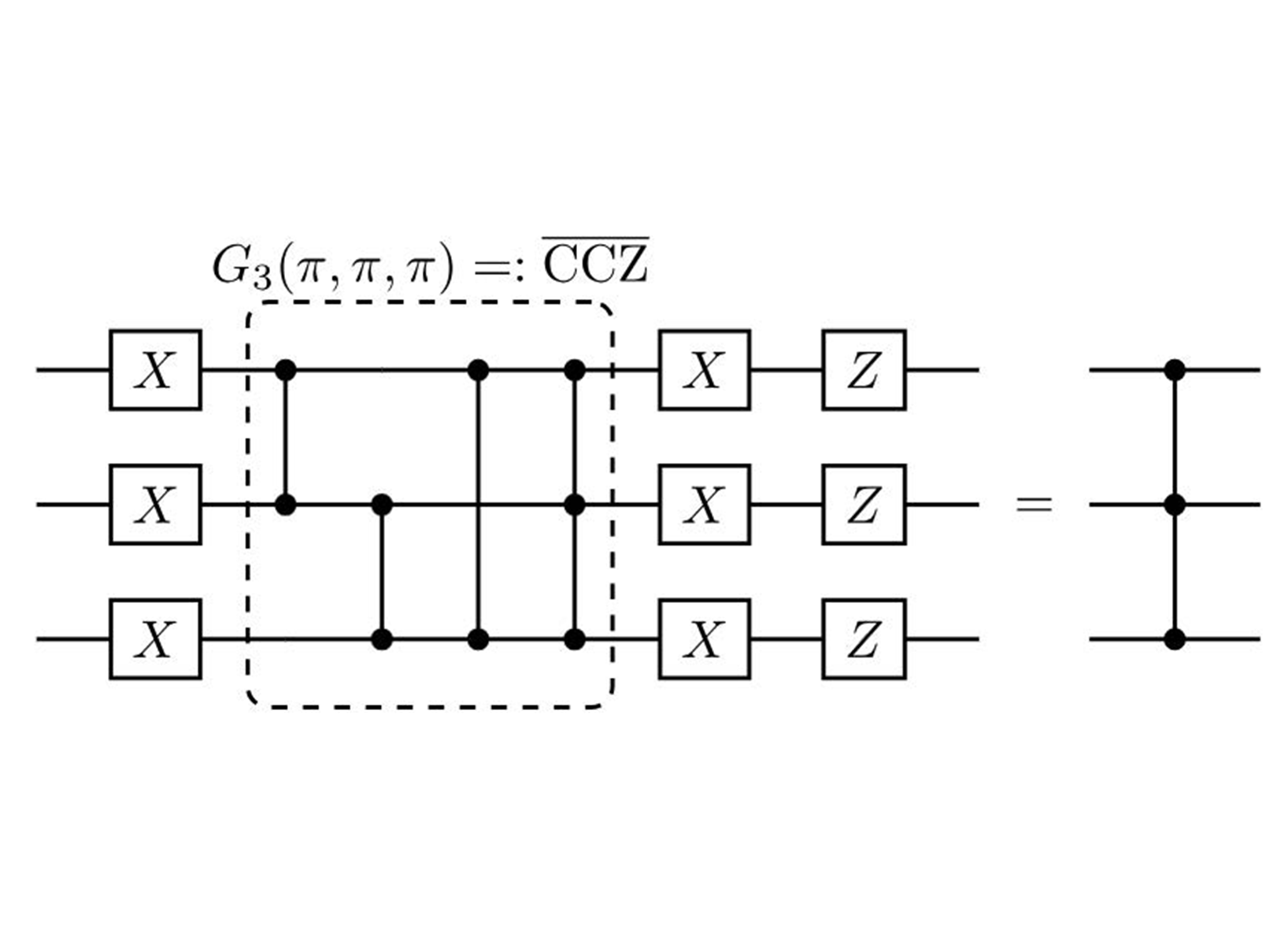 Figure 1: Schematic implementation of a multiqubit Rydberg gate used for quantum error correction. A three-qubit CCZ-type operation can be realized by combining
a global Rydberg pulse with single-qubit rotations, providing a hardwareefficient
primitive for measurement-free fault-tolerant protocols.
Figure 1: Schematic implementation of a multiqubit Rydberg gate used for quantum error correction. A three-qubit CCZ-type operation can be realized by combining
a global Rydberg pulse with single-qubit rotations, providing a hardwareefficient
primitive for measurement-free fault-tolerant protocols. 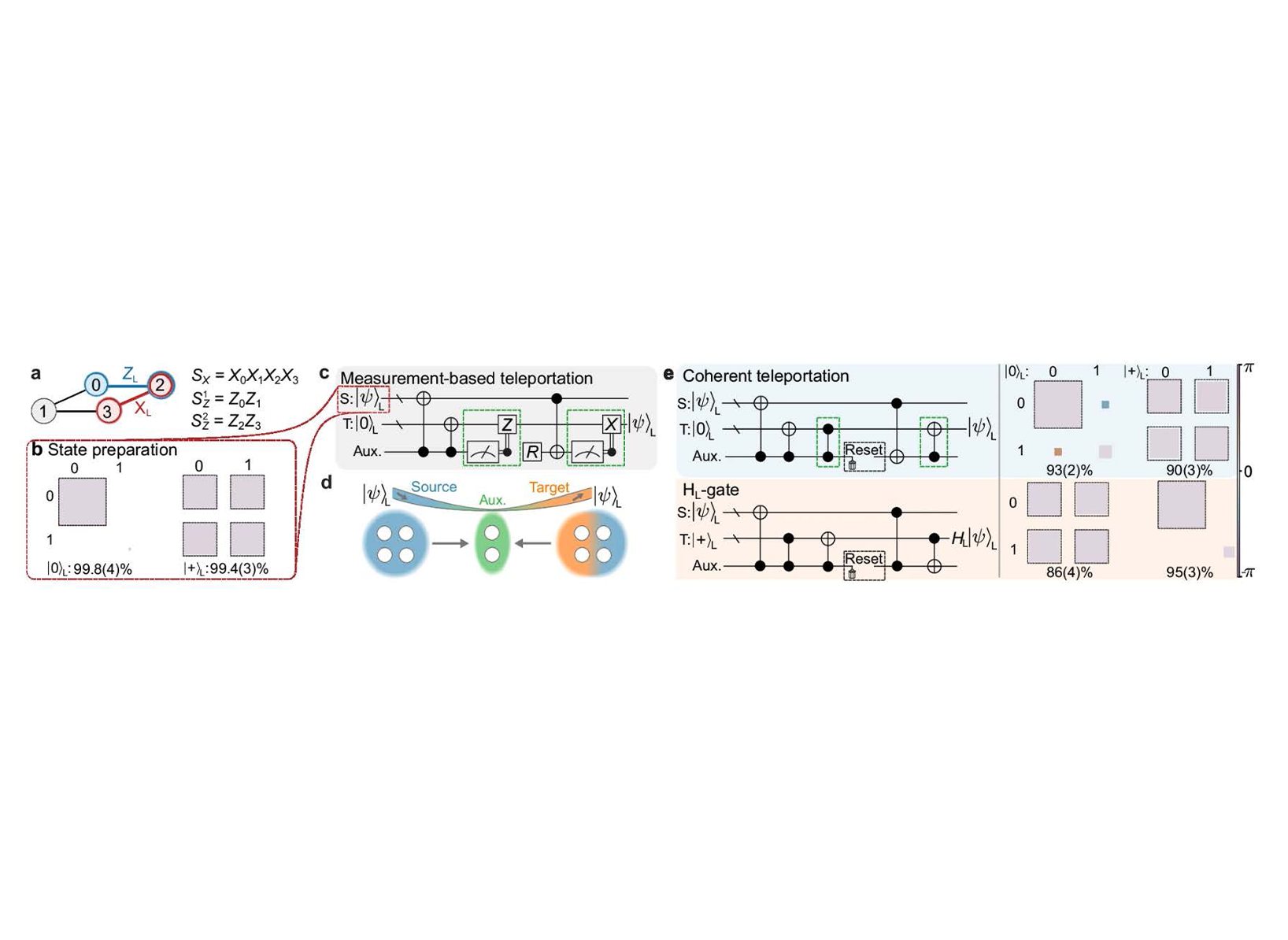 Measurement-free logical operations with small error-detecting codes. The figure illustrates logical state preparation, modular teleportation between encoded
blocks, and coherent-feedback circuits that replace mid-circuit measurements
and feed-forward operations. Experimental tomography data show the
performance of the implemented logical operations.
Measurement-free logical operations with small error-detecting codes. The figure illustrates logical state preparation, modular teleportation between encoded
blocks, and coherent-feedback circuits that replace mid-circuit measurements
and feed-forward operations. Experimental tomography data show the
performance of the implemented logical operations. Understanding, modelling, and controlling open many-body quantum systems remains central both for fundamental physics and for the development of quantum technologies. In this project, we study how non-equilibrium quantum dynamics can be used for quantum error correction, robust information storage, and scalable fault tolerant quantum computation. The project combines three closely connected directions. First, we investigate atomic, molecular, and optical platforms as candidates for quantum simulation and quantum computing. Second, we study how quantum-mechanical effects and open-system dynamics can be exploited in neural network-inspired models, including quantum generalizations of associative memories and decoders. Third, we develop, simulate, and benchmark quantum error-correction protocols and topological or low-density-parity-check codes under realistic noise models. Large-scale numerical simulations are essential for these goals. The computational tasks include time evolution of open quantum systems, tensor-network calculations, stabilizer and state-vector simulations of noisy quantum circuits, and extensive Monte Carlo sampling over many noise realizations. These calculations exceed the practical capabilities of local workstations, while the CLAIX HPC infrastructure allows us to reach the necessary system sizes, runtimes, and statistical accuracy.
Project Details
Project term
February 1, 2025–March 31, 2026
Affiliations
RWTH Aachen University
Institute
Institute for Quantum Information
Principal Investigator
Methods
We use a combination of complementary numerical approaches adapted to the different physical models and error-correction protocols studied in the project. For small open quantum systems, we perform exact density-matrix simulations using the Python package QuTiP. These simulations are useful for benchmarking and for obtaining detailed physical insight in systems of limited size. For larger open system dynamics, we use quantum-trajectory methods, where many stochastic pure state evolutions are simulated and averaged to reconstruct the corresponding density-matrix dynamics. For many-body systems, we employ tensor-network techniques such as density matrix renormalization group methods. Matrix product state representations allow us to reduce the effective Hilbert-space dimension by controlling the bond dimension while retaining the relevant many-body physics. For quantum error-correction circuits, we use simulation frameworks such as PECOS, Stim and Cirq to model circuits and noise processes separately. Stabilizer simulations allow efficient treatment of Clifford circuits with Pauli noise, while state-vector simulations are used when more general or hardware-specific noise models are required. Logical error rates and related performance metrics are estimated through Monte Carlo sampling over many trajectories and parameter points.
Results
During the reporting period, we made substantial progress in the development and benchmarking of fault-tolerant quantum error correction protocols for realistic quantumcomputing architectures. A major focus was the use of native three-qubit and multiqubit gates to reduce circuit depth and improve stabilizer readout. For superconducting qubits, we optimized a native CZZ gate for surface-code syndrome extraction and found that it can improve thresholds and reduce logical error rates compared with standard CZbased readout schedules [1]. More generally, we showed that three-qubit-gate stabilizer measurements can be strictly fault tolerant in unrotated surface codes and may reduce logical error rates by up to one order of magnitude in favorable regimes [3]. We also advanced fault-tolerant logical operations and decoding methods for more compact quantum error-correcting codes. For lift-connected surface codes, we constructed addressable logical Clifford gates and a fault-tolerant magic-state preparation scheme, providing a path toward a universal gate set in high-rate qLDPC codes [2]. For threedimensional color codes with boundaries, we developed a restriction-based decoder with optimal subthreshold scaling and a substantially improved threshold, together with a visualization package for 2D and 3D color-code decoding [7]. A further line of work concerned measurement-free and hardware-adapted quantum error correction. For trapped Rydberg ions, we proposed fast native CCZ gates and used them to construct a fully fault-tolerant, measurement-free Bacon–Shor protocol [4]. For neutral atoms, we developed optimized global Rydberg-pulse schemes for multiqubit gates relevant to measurement-free QEC and Floquet-code stabilizer readout [8]. We developed and numerically benchmarked a full architecture for measurement free fault-tolerant and universal quantum computation, and in close connection with experimentalists, led work on the demonstration of measurement-free universal logical quantum computation on a trapped-ion processor, published in the high-impact journals Science Advances and Nature Communications [6, 9]. Finally, we developed and numerically tested an experimentally informed decoding method that extracts decoder weights directly from syndrome correlations measured in a surface-code experiment [5].
Discussion
In summary, as discussed above, over the past year, we have further advanced hardwareaware fault-tolerant quantum error correction by developing multiqubit gate-based protocols, improved decoding methods, and logical gate constructions for compact quantum codes. Several results were directly connected to experimental platforms, including trapped ions, superconducting qubits, neutral atoms, and Rydberg-ion systems, emphasizing the close interplay between numerical modelling, protocol design, and practical implementation. For the numerical contributions in these works, access to the CLAIX compute infrastructure was crucial. In the next period, we will continue to work on multiqubit gates and hardware-specific error correction protocols, extend measurement-free schemes to larger codes and more realistic noise models, develop fault-tolerant methods for preparing finer-angle magic states, and develop decoders that combine theoretical code structure with experimentally observed error correlations. These tasks will continue to rely on large-scale simulations on CLAIX, in particular for Monte Carlo sampling, pulse optimization, and circuit-level benchmarking of logical error rates.
Additional Project Information
DFG classification: 308 Optics, Quantum Optics and Physics of Atoms, Molecules and Plasmas
Software: Python3, Matlab, Mathematica
Cluster: CLAIX
Publications
Stephan Tasler, Josias Old, Lukas Heunisch, Verena Feulner, Timo Eckstein, Markus Müller, Michael J. Hartmann,
“Optimizing Superconducting Three-Qubit Gates for Surface-Code Error Correction,”
arXiv [2506.09028], 2025.
osias Old, Juval Bechar, Markus Müller, Sascha Heußen,
“Addressable faulttolerant universal quantum gate operations for high-rate lift-connected surface codes,”
arXiv [2511.10191], 2025.
Josias Old, Stephan Tasler, Michael J. Hartmann, Markus Müller,
“Fault-Tolerant Stabilizer Measurements in Surface Codes with Three-Qubit Gates,”
Phys. Rev. Lett., 2025, 135, 240601.
Katrin Bolsmann, Thiago L. M. Guedes, Weibin Li, Joseph W. P. Wilkinson,
Igor Lesanovsky, Markus Müller,
“Fast Native Three-Qubit Gates and Fault-Tolerant Quantum Error Correction with Trapped Rydberg Ions,”
arXiv [2512.16641], 2025.
Ants Remm, Nathan Lacroix, Lukas Bödeker, Elie Genois, Christoph Hellings,
Fran¸cois Swiadek, Graham J. Norris, Christopher Eichler, Alexandre Blais, Markus
Mü ller, Sebastian Krinner, Andreas Wallraff,
“Experimentally informed decoding of stabilizer codes based on syndrome correlations,”
Phys. Rev. Research, 2026, 8, 013044.
Friederike Butt, Ivan Pogorelov, Robert Freund, Alex Steiner, Marcel Meyer,
Thomas Monz, Markus Müller,
“Demonstration of measurement-free universal logical quantum computation,” Nat. Commun., 2026, 17, 995.
Friederike Butt, Lars Esser, Markus Müller,
“Decoding three-dimensional color codes with boundaries,”
Phys. Rev. A, 2026, 113, 042416.
David F. Locher, Josias Old, Katharina Brechtelsbauer, Jakob Holschbach, Hans
Peter Büchler, Sebastian Weber, Markus Müller,
“Multiqubit Rydberg Gates for Quantum Error Correction,”
arXiv [2512.00843], 2026 (accepted for publicationin PRX Quantum).
Friederike Butt, David F. Locher, Katharina Brechtelsbauer, Hans Peter Büchler,
and Markus Müller,
“Measurement-free, scalable, and fault-tolerant universal quantum computing,” Science Advances 11(33), eadv2590, 2025.