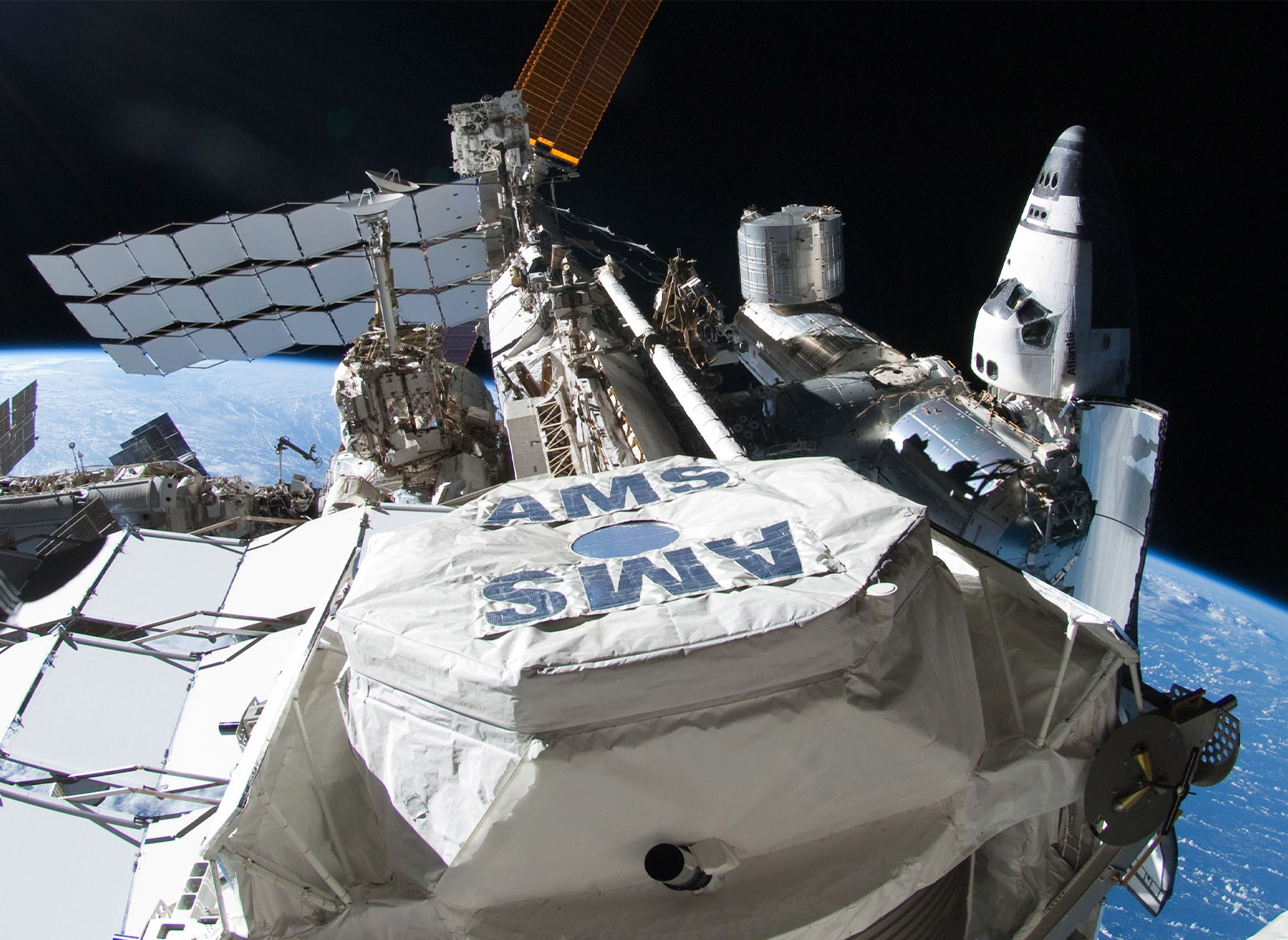
 The Alpha Magnetic Spectrometer on the International Space Station.
 The Alpha Magnetic Spectrometer (AMS) is a detector designed for precision spectroscopy of cosmic rays that was installed on the International Space Station (ISS) in May 2011 (Fig. 2). With dimensions of 5 × 4 × 3m3 and a weight of 7.5 tons, AMS is the largest cosmic-ray spectrometer ever built. Led by Nobel laureate Professor Samuel Ting from MIT, AMS has been constructed and is now operated by an international collaboration of more than 200 scientists and engineers, from Europe, America and Asia. The overall construction costs, including the flight of AMS to the Space Station aboard Space Shuttle Endeavour, have amounted to 1.5 billion US dollars. AMS is the only magnet spectrometer in space and the largest instrument for basic research on the ISS.
As a multi-purpose instrument, AMS was conceived to answer fundamental questions about our Universe: What is the nature of Dark Matter? What happened to the antimatter that must have been produced in the Big Bang? Where are cosmic rays accelerated and how do they propagate through the Milky Way? Answers to these questions will have a profound impact on our understanding about the inner workings of our Universe and help advance fundamental science. In particular, the search for dark matter complements the search for new elementary particles at the Large Hadron Collider at CERN, Geneva.
AMS has recorded over 255 billion individual particle crossings (called events), more than all previous cosmic-ray experiments combined. The raw data volume collected is on the order of 40 TB per year. AMS employs redundant subdetectors for particle identification and for energy or momentum measurements. Before any physics analysis of the data can be performed, the information from all subdetectors has to be pieced together and complicated reconstruction algorithms have to be run for each of them. The resulting high-level data serves as the input for physics analyses and occupies a volume of 160 TB per year of AMS flight on disk. HPC resources are vital for the processing, calibration, and analysis of this enormous dataset.
Project Details
Project term
April 1, 2025–March 31, 2026
Affiliations
RWTH Aachen University
Institute
I. Physikalisches Institut B
Principal Investigator
Methods
The majority of the HPC resources allocated to the project are spent on Monte Carlo simulations, which are an essential ingredient of the physics analyses of AMS data. The interactions of cosmic-ray particles entering AMS with the detector components are modelled together with the detector responses that convert energy depositions in the sensitive material to digitized output that has the same format as the event records stored by AMS for actual cosmic rays. The simulations are used to study reconstruction algorithms, extract effective acceptances for measurements of cosmic-ray fluxes, and determine the background levels due to misidentification or misreconstruction of particles. For the analysis of AMS data, we use a dedicated event format optimized for fast parallel I/O.
Results
Twenty-nine publications by the AMS collaboration have appeared in the renowned Physical Review Letters, most of which have been selected as an Editor’s suggestion. The findings have received considerable attention among astrophysicists and triggered an enormous amount of theoretical work. The physics highlight of AMS in 2025 was the precise measurement of the fluxes of Lithium isotopes in cosmic rays. Establishing the origin of Li has an important impact on understanding the formation of the Universe and its chemical evolution. For rigidities above 7 GV, AMS found an identical rigidity dependence of the 6Li 7Li fluxes. This shows that both 6Li 7Li are produced by collisions of heavier cosmic-ray nuclei with the interstellar medium and excludes the existence of a sizable primary component in the 7Li flux.
Discussion
For the antihelium search, we have again been able to produce a substantial amount of simulations in the latest version of the AMS detector description and reconstruction, which uses an improved track fit to counter the effects of multiple scattering and comes with a vastly improved tracker alignment. The simulations consist mostly of helium-4 nuclei. They are used both in the training of multivariate classifiers for the suppression of charge confusion from instrumental backgrounds, which means wrongly identifying a helium nucleus as antihelium, and for the estimation of the remaining background level after signal selection cuts.
AMS has reported in public seminars having recorded cosmic-ray events compatible with antihelium nuclei. Such events are difficult to reconcile with standard astrophysical production, which predicts antihelium fluxes many orders of magnitude below the detectable level. An explanation proposed in the literature suggests that dark matter annihilation into heavy quarks, particularly the channel, could yield antihelium. However, first results on a search for antihelium-3 production using LHCb data were finalised by our group and rule out such a model by approximately two orders of magnitude
We have investigated the potential of AMS for gamma-ray astronomy, with a long term goal of looking for transient events not detected by the Fermi-LAT and cross-checking the energy spectrum of the diffuse Galactic emission. We are now able to use the latest AMS reconstruction software to identify two classes of photon events. In the first class, a photon converts into an electron-positron pair in the AMS detector material and the charged particles are then measured in the silicon tracker of AMS. For the first time, it is possible to use the standard AMS track finding for this purpose. In the second class, a photon traverses AMS and then deposits its energy in the electromagnetic calorimeter at the bottom of AMS.
Additional Project Information
DFG classification: 311 Astrophysics and Astronomy
Software: ROOT framework, AMS analysis software, LHCb simulation software
Cluster: CLAIX
Publications
Aguilar, M. et al. (AMS Collaboration),
Propertied of Daily Helium Fluxes,
https://dx.doi.org/10.1103/PhysRevLett.128.231102, June 2022
Aguilar, M. et al. (AMS Collaboration),
Properties of Cosmic-Ray Sulfur and Determination of the Composition of Primary Cosmic-Ray Carbon, Neon, Magnesium, and Sulfur: Ten-Year Results from the Alpha Magnetic Spectrometer,
https://dx.doi.org/10.1103/PhysRevLett.130.211002, May 2023
Aguilar, M. et al. (AMS Collaboration),
Temporal Structures in Electron Spectra and Charge Sign Effects in Galactic Cosmic Rays,
https://dx.doi.org/10.1103/physrevlett.130.161001, April 2023
Jaro Drongowski,
Suche nach Positronen in den Daten des AMS-02 Experiments auf der Internationalen Raumstation, August 2023
Aguilar, M. et al. (AMS Collaboration),
Temporal Structures in Positron Spectra and Charge-Sign Effects in Galactic Cosmic Rays,
https://dx.doi.org/10.1103/physrevlett.131.151002, October 2023
Miguel Aguilar, et al,
Properties of Cosmic Lithium Isotopes Measured by the Alpha Magnetic Spectrometer,
https://dx.doi.org/10.1103/PhysRevLett.134.201001, May 2025
Miguel Aguilar, et al,
Properties of Cosmic Deuterons Measured by the Alpha Magnetic Spectrometer,
https://doi.org/10.1103/PhysRevLett.132.261001, June 2024
Miguel Aguilar, et al,
Solar Modulation of Cosmic Nuclei over a Solar Cycle: Results from the Alpha Magnetic Spectrometer,
https://doi.org/10.1103/PhysRevLett.134.051001, February 2025
Miguel Aguilar, et al,
Antiprotons and Elementary Particles over a Solar Cycle: Results from the Alpha Magnetic Spectrometer,
https://doi.org/10.1103/PhysRevLett.134.051002, February 2025
LHCb Collaboration, Antihelium production in decays,
https://cds.cern.ch/record/2905862
Thesis:
Mareike Berkner,
Massenbestimmung mit dem AMS-02 Detektor auf der ISS (2022),
Bachelor thesis, 2022
Sichen Li,
Measurement of the antiproton to proton flux ratio with the Alpha Magnetic Spectrometer on the International Space Station
PhD thesis, https://dx.doi.org/10.18154/RWTH-2023-06030, June 2023
Lennart Seibel,
Messung der Energiespektren von schweren Kernen in den Daten des AMS-02 Experiments auf der Internationalen Raumstation,
Bachelor Thesis, July 2023
Robin Sonnabend,
Search for Antihelium Nuclei in Cosmic Rays with the AMS-02 experiment on the International Space Station,
PhD thesis, RWTH Aachen University, November 2023,
https://publications.rwth-aachen.de/record/973566
Mareike Berkner,
Massenbestimmung mit dem AMS-02 Detektor auf der ISS,
PhD thesis, 2024
Benjamin Gudisch,
Zeitliche Stabilität des Elektronen-Flusses in der kosmischen Strahlung,
BSc thesis, August 2024
Leonard Schramm,
Particle Identification with Autoencoders for the AMS-02 Experiment on the International Space Station,
Master Thesis, July 2024
Hanna Meuten,
Untersuchung der zeitlichen Stabilität des Übergangsstrahlungsdetektors von AMS-02,
BSc thesis, October 2024
Lukas Höfer,
Reconstruction of converted photons with AMS-02,
Master thesis, June 2025
Arne Boland,
Suche nach Antihelium beim AMS-02-Experiment auf der Internationalen Raumstation mit dem Optuna-Framework,
Bachelor thesis, July 2025
Jaro Drongowski
New Algorithms for the Reconstruction of Converted Photons with the AMS-02 Silicon Tracker,
Master thesis, November 2025
In cooperation with the Computer Graphics Group at RWTH (Prof. Kobbelt), we have performed a MSc thesis project investigating the use of Deep Learning autoencoders for particle identification in AMS:
Leonard Schramm,
Particle Identification with Autoencoders for the AMS-02 Experiment on the International Space Station,
MSc thesis, July 2024.