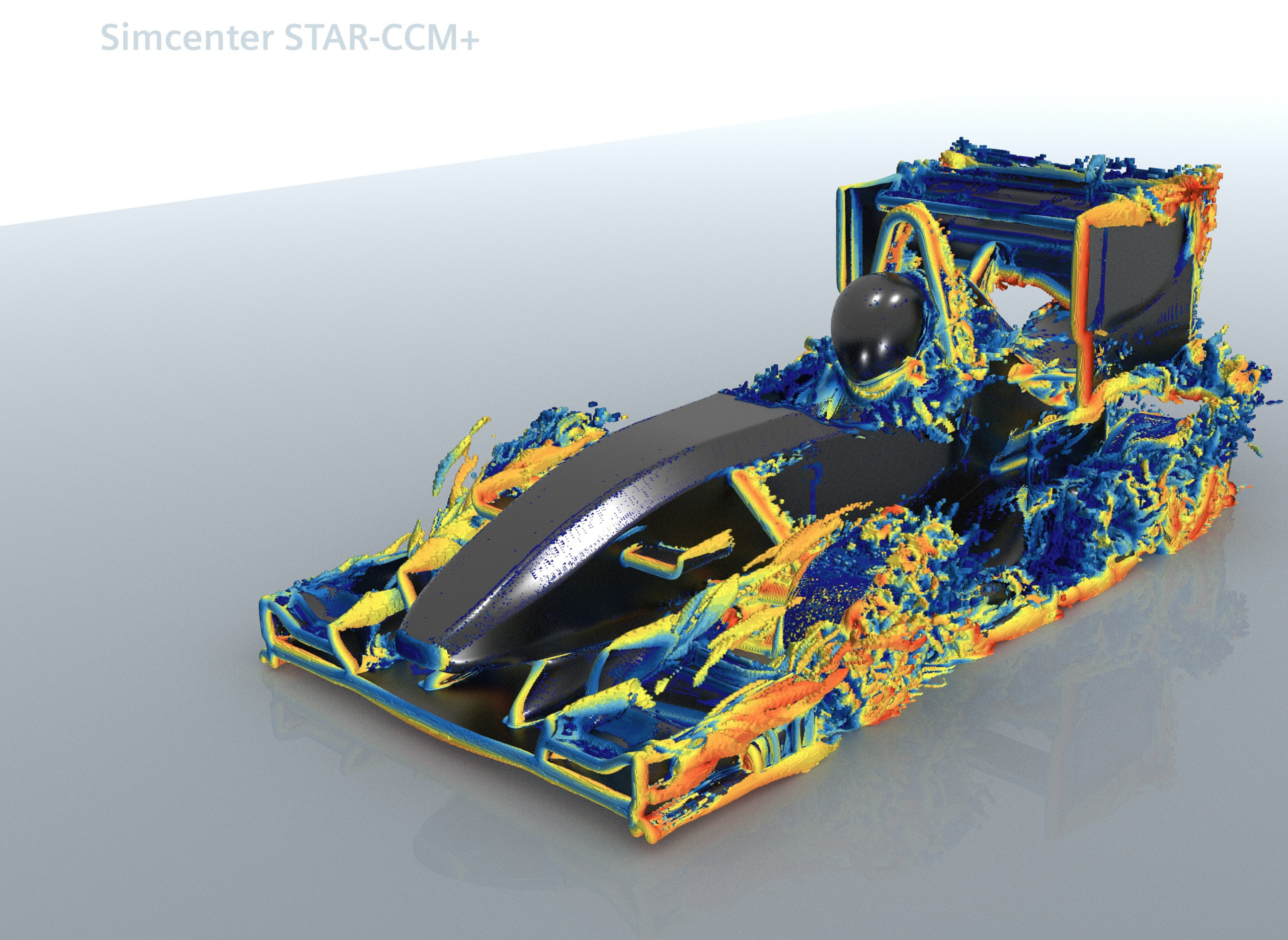
 This is a picture taken from our unsteady simulation video.
 Every year starting in September we, as the Formula Student Team of RWTH Aachen University, develop a completely new electric race car which is also able to drive autonomously. With this race car, we compete against universities worldwide in various disciplines that evaluate both vehicle performance and engineering design. Two big factors contributing towards vehicle performance are aerodynamics and thermal management. In order to find the best aerodynamic surfaces and develop efficient cooling systems within the regulatory constraints and while keeping performance compromises with other design areas in mind we conduct extensive and highly detailed CFD studies using Simcenter Star-CCM+.
Project Details
Project term
February 25, 2025–February 28, 2026
Affiliations
RWTH Aachen University
Institute
Center for Computational Engineering Science
Principal Investigator
Methods
Over the years, our simulations have been developed further and further to improve accuracy, resulting in several simulation approaches being used currently, depending on the desired information about the different aerodynamic phenomena and influences on the racetrack. These include a straight-line half car simulation using a symmetry plane which consists of around 60 million cells, a full car simulation with a yawed car and turned front tires as well as a cornering simulation, the latter two both using around 120 million cells. Also in case of just Rearwing development we are able to introduce a plane in front of it with preset velocity conditions so we can reduce the cell count to 50 million. In our development process, we mainly use the straight-line and yaw-angle simulations as they provide much quicker turnaround times and yield enough information. The yawed car is used to include the influence of various driving states on our aerodynamic performance. This is especially important because the purpose of our high downforce vehicle concept is to increase performance in grip-limited driving conditions, which means those are also the situations in which the car state differs most from the neutral state. This is also the reason for the development of the cornering simulation. Here, the car can be fully transformed to represent real driving situations in corners, including a curved wind tunnel which makes sure that the air flow relative to the vehicle matches the real air flow during cornering. Once we have settled with a solid concept we use an optimization algorithm to extract the last bit of performance possible. For all these simulations we are using a coupled solver with the k-Omega SST turbulence model. Apart from the external aerodynamics, we also use CFD simulations for the design of our cooling systems. These include a water-cooling circuit for our four electric motors and the corresponding inverters as well as an air-cooled battery and car PC. Apart from system simulation in MATLAB Simulink, we use thermal CFD simulations to analyze their behavior.
Results
Thanks to our continued access to HPC resources, we were able to develop competitive aerodynamic and cooling solutions that contributed to a successful 2025 competition campaign. Compared to the 2023/2024 season, we achieved an improvement in f 0.2 and developed a new cooling system for the CarPC, which is essential for autonomous driving. A big emphasis has also been put on validating the results from our CFD simulations. We gathered velocity and pressure data in a wind tunnel and on track using flow measurement probes, measured the aerodynamic forces using a loadcell in the suspension rods and applied visual validation techniques. The technical changes implemented during the season directly translated into strong on-track performance across multiple events.Most notably, we placed first in Autocross at Formula Student Austria, recorded the fastest time in Driverless Acceleration at Formula Student Czech, and finished second overall at Formula Student Germany, securing first places in both Autocross and Skidpad. The quality of our engineering practices was further recognized with a third-place finish in the Engineering Design event at Formula Student Czech.
For this season we had a big regulation change regarding our Rearwing which lost us a lot of performance, bringing our from -7.2 to -6.1. Thanks to the new methods we developed we managed to gain back 0.8 bringing our total to slightly above -6.9. Besides that in the cooling department we had to further develop our battery inlet and outlet to make sure the new battery concept works properly. Our plans for the next months is to build a 50% scale car to further validate our simulation in the wind tunnel.
Discussion
Our methods thus far have proven to lead us towards well performing designs when compared against other Formula Student Teams. In order to keep on improving our engineering practices there are many different aspects that need to be reevaluated again and again. Many of those are on a lower system level and include things such as the relevant driving states for which we should optimize or the design and simulation workflow. Correlating the simulations to data gathered during on track testing still poses a big challenge but is vital to evaluate performance and provide realistic aerodynamic maps to the vehicle control unitrelevant driving states for which we should optimize or the design and simulation workflow.
Additional Project Information
DFG classification: 404-03 Fluid Mechanics
Software: Star-CCM+
Cluster: CLAIX
Publications
Thesis
Simon Wilms,
Validation of CFD-Derived Aerodynamic Characteristics and Flow Fields of a Formula Student Race Car Using Wind Tunnel Experiments,
May 2025, Bachelor Thesis
Richard Wulf,
Development of a measuring probe and a calibration procedure for the incident flow condition of a vehicle with numerical simulation,
August 2022, Bachelor Thesis