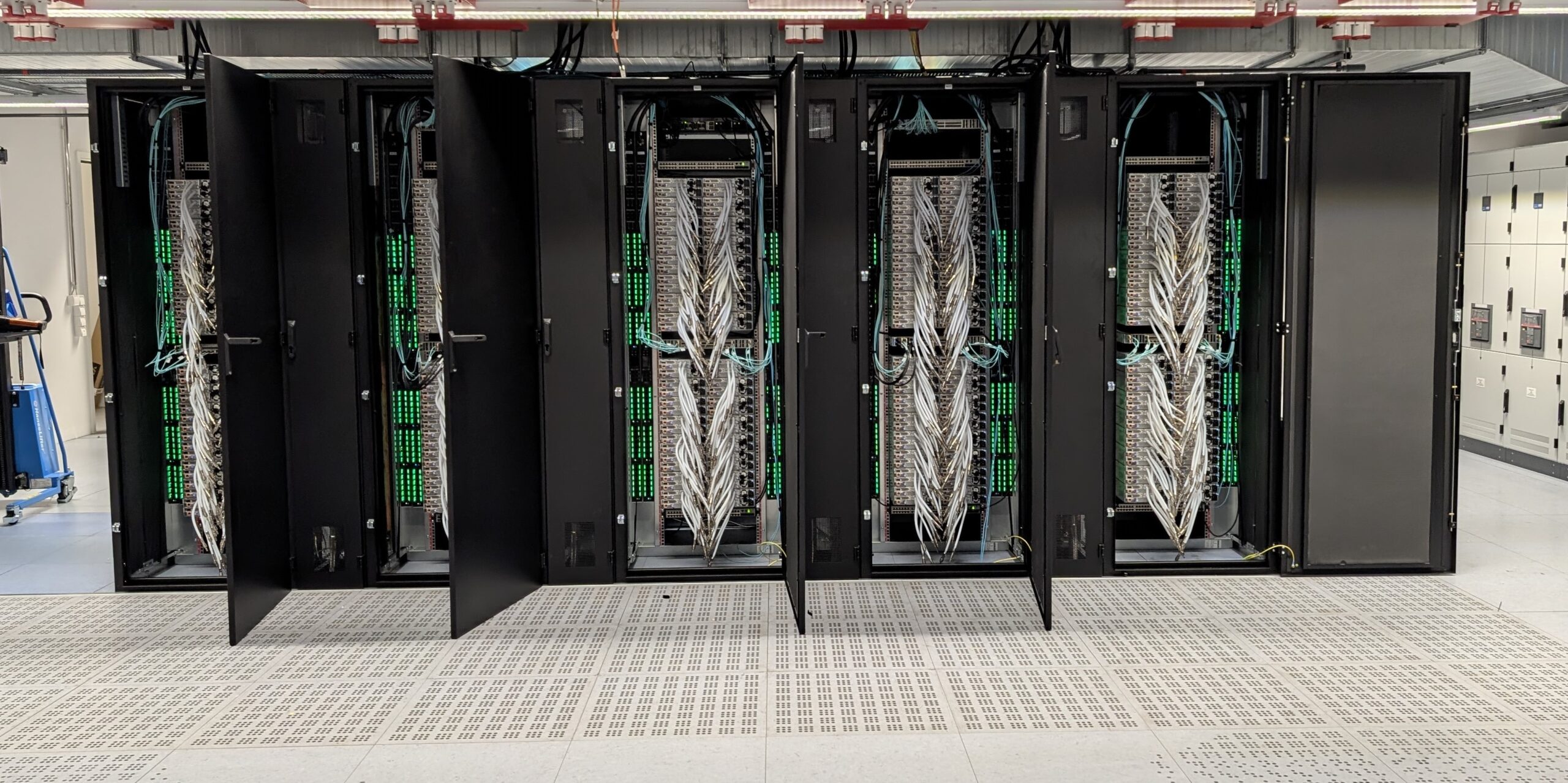
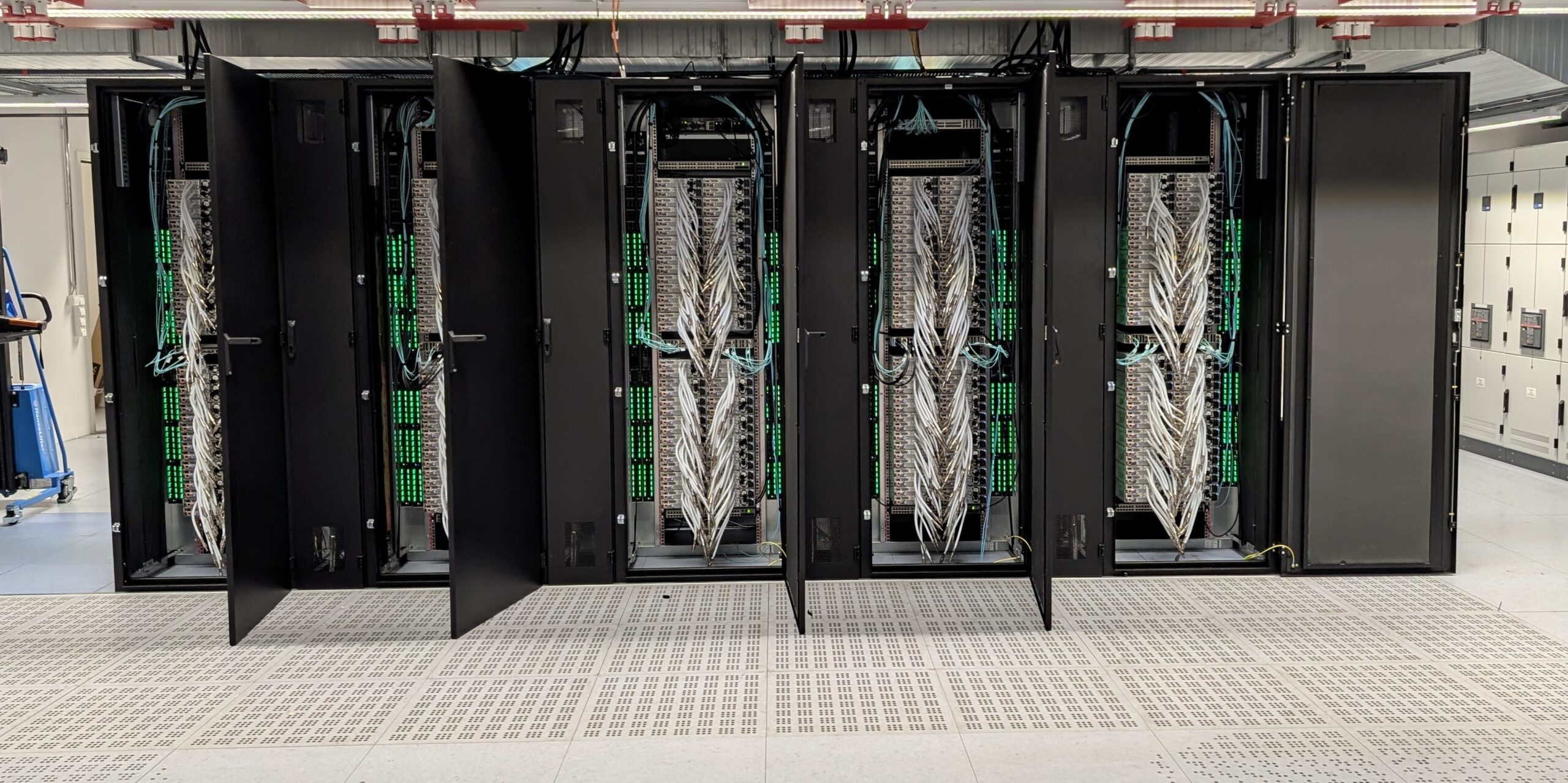
It’s summer 2026 – what’s missing at NHR4CES@RWTH ? The CLAIX-2025 HPC system isn’t yet in production! As part of the proven 1-cluster concept, CLAIX-2025 is intended to complement the existing CLAIX-2023 system at the Tier-2 level. We spoke with our HPC experts at the IT Center RWTH Aachen to find out why the commissioning has been delayed and what the current status is. Sascha Bücken, Group Leader “Server, Storage, HPC,” Tim Cramer, Group Leader “HPC CORE,” and Christian Terboven, Chief HPC Officer, answer the question on the minds of researchers at RWTH Aachen and across Germany:
What has happened since April?
Sascha Bücken: Since our last update, significant progress has been made in commissioning CLAIX-2025. The large Cooling Distribution Unit (CDU) was delivered, installed, and successfully commissioned. This allowed us to replace the temporary CDUs that had been in use until now. Thanks to the additional cooling capacity, there is now sufficient capacity to fully cool both the CPU and GPU systems of the new cluster.
Further progress has also been made with the network infrastructure. The stability of the CN5000 fabric has been gradually improved through the replacement of various system components and the continuous further development of the software stack. In addition, several CN5000 Ethernet gateways were put into operation, and an automatic failover mechanism was set up to further increase the infrastructure’s reliability.
Why is the commissioning still delayed?
Sascha Bücken: The commissioning is currently delayed primarily due to ongoing work to further stabilize the fabric. In addition, the switch to a newer version of the software stack is still pending, which is a prerequisite for activating the so-called BLK service. This service is intended to improve network bandwidth via the gateways as well as read and write speeds on the file systems, so that the speeds specified in the request for proposals can be met.
What steps are currently being taken to ensure that CLAIX-2025 goes live in a timely manner?
Sascha Bücken: To complete the remaining work as quickly as possible, daily video conferences are currently taking place between technical experts from Cornelis, NEC, and the IT Center. In addition, the companies involved meet twice a week to discuss outstanding issues and coordinate the next steps.
What is the current plan?
Sascha Bücken: We currently hope to complete acceptance testing of the CPU partition by the end of June. After that, acceptance testing of the GPU partition will proceed at a rapid pace. As things stand, we expect CLAIX-2025 to be commissioned in phases starting at the end of June, although the exact timeline will continue to depend on the results of the ongoing tests and optimization measures.
And now to the details behind the delay. When was CLAIX-2025 originally scheduled to go live?
Sascha Bücken: CLAIX-2025 was originally scheduled to go live this year. CLAIX-2025 consists of two segments: the classic HPC segment, which was scheduled to launch in March 2026, and the machine learning (ML) segment, which is set to be accepted in June 2026. If we look at this original and contractually agreed-upon schedule, we’re actually right on track! However, in the early phase of the CLAIX-2025 build, we had thought that we could commission the system earlier—before the end of 2025. We communicated this to our users and, up until the fourth quarter of 2025, we also assumed that this ambitious goal could be achieved.
Why didn’t this new schedule work out?
Christian Terboven: CLAIX-2025 is one of the world’s first HPC systems to be delivered with the Cornelis CN5000 HPC interconnect. While this is the successor technology to Omni-Path, it has been significantly revised. As a result, our environment also had to be adapted in many areas and, in some cases, developed from scratch. The network’s stability also had to be established during the weeks of test operation before we could begin the acceptance benchmarks and user applications required for acceptance.
Tim Cramer: In addition, there were unexpected delivery delays beforehand—specifically regarding the import of components into the EU—for the hot water cooling system: The system is operated with hot water cooling, which requires a so-called CDU (Cooling Distribution Unit). This CDU could not be delivered until March 2026.
What does this currently mean for users?
Tim Cramer: Unfortunately, this leads to longer wait times—in both the HPC and ML segments—than our users are accustomed to. Since we’ve seen that our users need more computing capacity, we’ve tried to launch CLAIX-2025 as quickly as possible, and all suppliers have cooperated to the best of their ability.
CLAIX-2023 is currently overbooked. We’re working on this: For example, through changes to Slurm, we’ve been working to ensure greater fairness in wait times. Unfortunately, this doesn’t, of course, solve the problem of the lack of resources. We can only ask for your patience at this time! Once CLAIX-2025 goes live, the HPC segment in Tier-2 will triple, and we will be able to offer users the computing time capacity they need!
What can users expect
Christian Terboven: CLAIX-2025 will provide significant additional CPU computing power to strengthen the field of traditional HPC simulations. Furthermore, a targeted expansion in the area of machine learning represents an important step forward. CLAIX-2025 was designed not only as a response to rising demand but as a strategic investment in the data-driven scientific work of tomorrow.
We will keep you updated on further developments regarding the commissioning of CLAIX-2025. If you have any questions or issues, the IT ServiceDesk team is here to help.