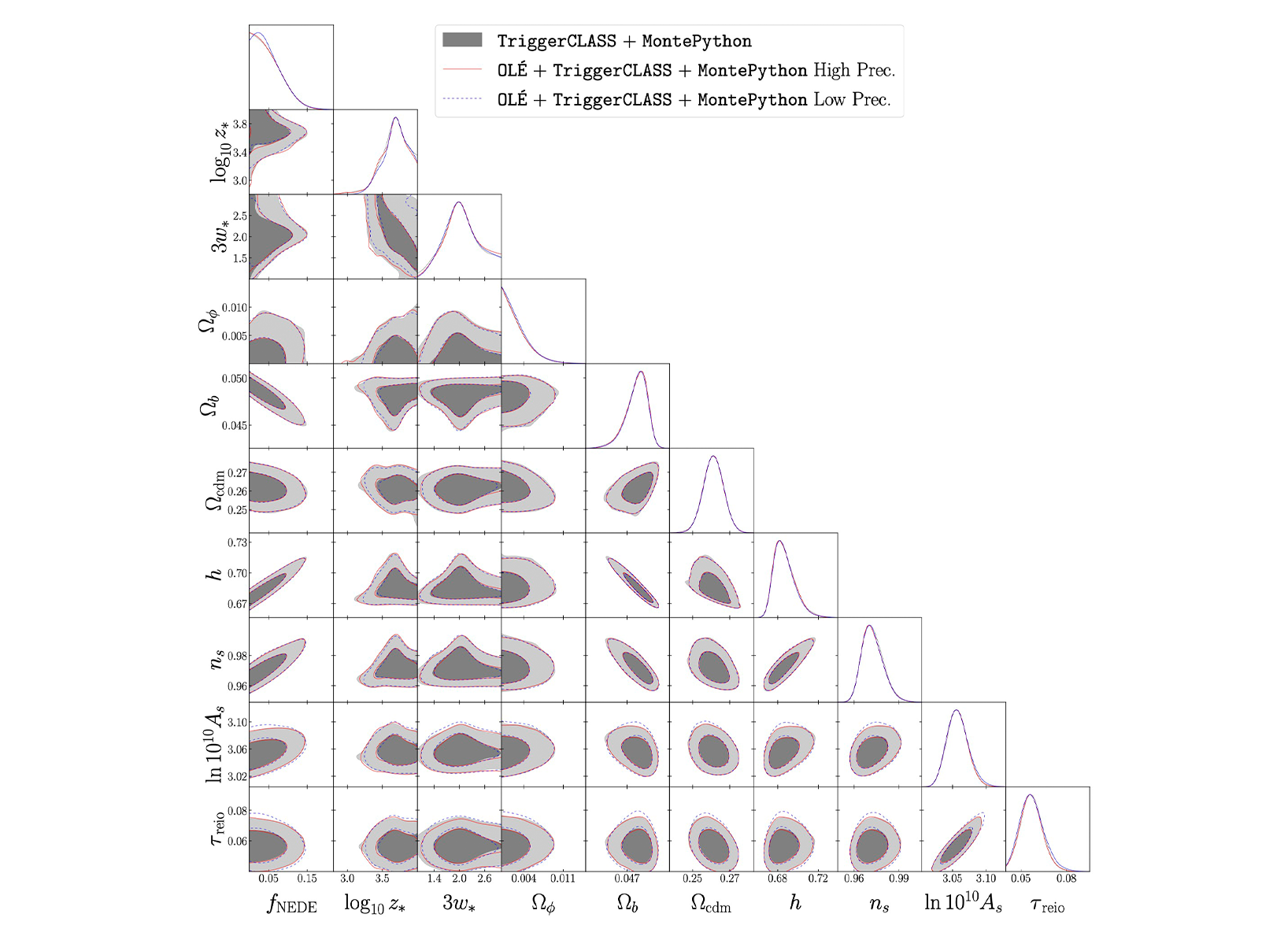
 Confidence contours on the cosmological parameters of the Early Dark Energy cosmological model, obtained using either full simulations (grey, 6300 CPUh) or the OLE emulator (red/blue, 800 CPUh)
The Aachen cosmology group has long-standing expertise in comparing cosmological models with observations. This is the central problem of cosmology. The goal is to determine which models and physical parameters provide the most accurate explanation of the observed distribution of galaxies, the observed maps of the cosmic microwave background, the luminosity of supernovae, and a few other observables. However, this involves simulating possible universes, which is a highly computationally intensive task. Furthermore, we must simulate thousands, or even millions, of possible universes, each with different cosmological parameters, in order to determine which models and parameter values are consistent with the data.
Project Details
Project term
May 2, 2025–May 1, 2026
Affiliations
RWTH Aachen University
Institute
Institute for Theoretical Particle Physics and Cosmology
Principal Investigator
Methods
There are two categories of simulation codes: Boltzmann codes, such as CLASS, which simulate the entire universe on very large scales of time and space, and N-body codes, such as GADGET, which focus on the formation of structures in regions of the recent universe. These codes are too slow to be run millions of times. We must therefore develop emulators. Most of this project was devoted to training and building emulators, and then using them to efficiently compare specific models against the data. Finally, for parameter inference, the slow theory code or fast emulators can be run multiple times to sample the space of free cosmological parameters using Markov-Chain Monte Carlo methods.
Results
In the first subproject, we ran some grids of N-body simulations to understand structure formation in a specific dark matter model. More specifically, we assumed that dark matter could scatter off neutrinos, which is a theoretically plausible hypothesis. Our simulation took into account various cosmological parameters, including different values for the dark matter scattering rate and the thermal history of the Universe. The first series of simulations, performed using the GADGET4 code, focused on galaxy clustering. The second series, performed using the P-Gadget3 code, focused on the distribution of hydrogen in the Universe. For each case, we built a fast emulator based on the simulation results. This allowed us to compare the model with observations—on the one hand, of galaxy maps, and on the other, of absorption lines in quasar spectra. We were thus able to demonstrate that there is no evidence of interactions between dark matter and neutrinos in the current data, and to establish the tightest limits to date on the corresponding scattering rate.
As part of the third subproject, we developed a new CLASS code emulator using an original active learning method that combines PCA decomposition, Gaussian processes, and self-assessment of accuracy. We validated and released this emulator, named OLE. We then used it and refined it in a series of papers in which we analyze various cosmological models. Among its main areas of application, we used OLE to compare the goodness of fit of several cosmological models in light of recent cosmological tensions—that is, apparent contradictions between different types of cosmological observations that could be resolved by identifying the correct cosmological model. The most well-known of these, known as the “Hubble tension,” has generated significant interest in the field. Thanks to this project and the power of the OLE emulator, we were able to run a considerable number of Markov Monte Carlo runs and publish several important papers demonstrating the ability of certain models to reduce or explain these tensions.
OLE also enabled us to perform sensitivity forecasts for the Euclid galaxy survey simply by fitting simulated Euclid data with a mock Euclid likelihood function. This allowed us to achieve the objectives of our second subproject.
Discussion
The most significant outcome of this project is undoubtedly the public release of the OLE emulator, which dramatically accelerates parameter inference and reduces CPU time by approximately one order of magnitude, thereby transforming parameter inference runs that used to take a full week on a hundred of CPUs into runs that converge overnight. The power of OLE has been highlighted in numerous publications and presented by our team at conferences and seminars in Europe, North America, and Asia. It has enabled us to produce important publications such as the “H0 World Cup”, the most comprehensive comparison to date between cosmological data and cosmological models aimed at explaining the Hubble tension. We are confident that this tool will continue to be used by our group and will gain wider adoption within the scientific community.
Additional Project Information
DFG classification: 311 Astrophysics and Astronomy
Software: Gadget-4, CLASS, MontePython, OLE, P-Gadget3
Cluster: CLAIX
Publications
DESI forecast for dark matter-neutrino interactions using EFTofLS,
OLÉ — Online Learning Emulation in cosmology,
Sven Günther, Lennart Balkenhol, Christian Fidler, Ali Rida Khalife, Julien Lesgourgues, Markus R. Mosbech, Ravi Kumar Sharma
https://dx.doi.org/10.1088/1475-7516/2025/09/059, September 2025
Constraints on neutrino mass and dark energy agnostic to the sound horizon,
Ravi Kumar Sharma, Julien Lesgourgues,
https://dx.doi.org/10.1088/1475-7516/2026/02/034, February 2026
Recoupled Dark Radiation reconciling CMB and DESI BAO measurements,
Ravi Kumar Sharma, Maria Archidiacono, Julien Lesgourgues,
Peer-reviewed publication, May 2026
The H0 world cup. II. A comprehensive competition between proposed Hubble tension solutions,
Nils Schöneberg, Vivian Poulin, Angelo G. Ferrari, Fabio Finelli, Julien Lesgourgues,
Peer-reviewed publication, July 2026
The H0 world cup. I. A comprehensive competition between proposed Hubble tension solutions,
Nils Schöneberg, Vivian Poulin, Angelo G. Ferrari, Fabio Finelli, Julien Lesgourgues,
Peer-reviewed publication, July 2026
High resolution Lyman-α forest constraints on dark matter-neutrino scattering,
Markus R. Mosbech, Olga Garcia-Gallego, Vid Iršič, Matteo Viel, Julien Lesgourgues,
Peer-reviewed publication, July 2026
Thesis:
Accelerating cosmological inference with emulators : a machine learning approach,
https://dx.doi.org/10.18154/RWTH-2025-07065, October 2025