Project
Evaluation of the filtration efficiency and protective effect of mouth-nose coverings in mechanically ventilated rooms
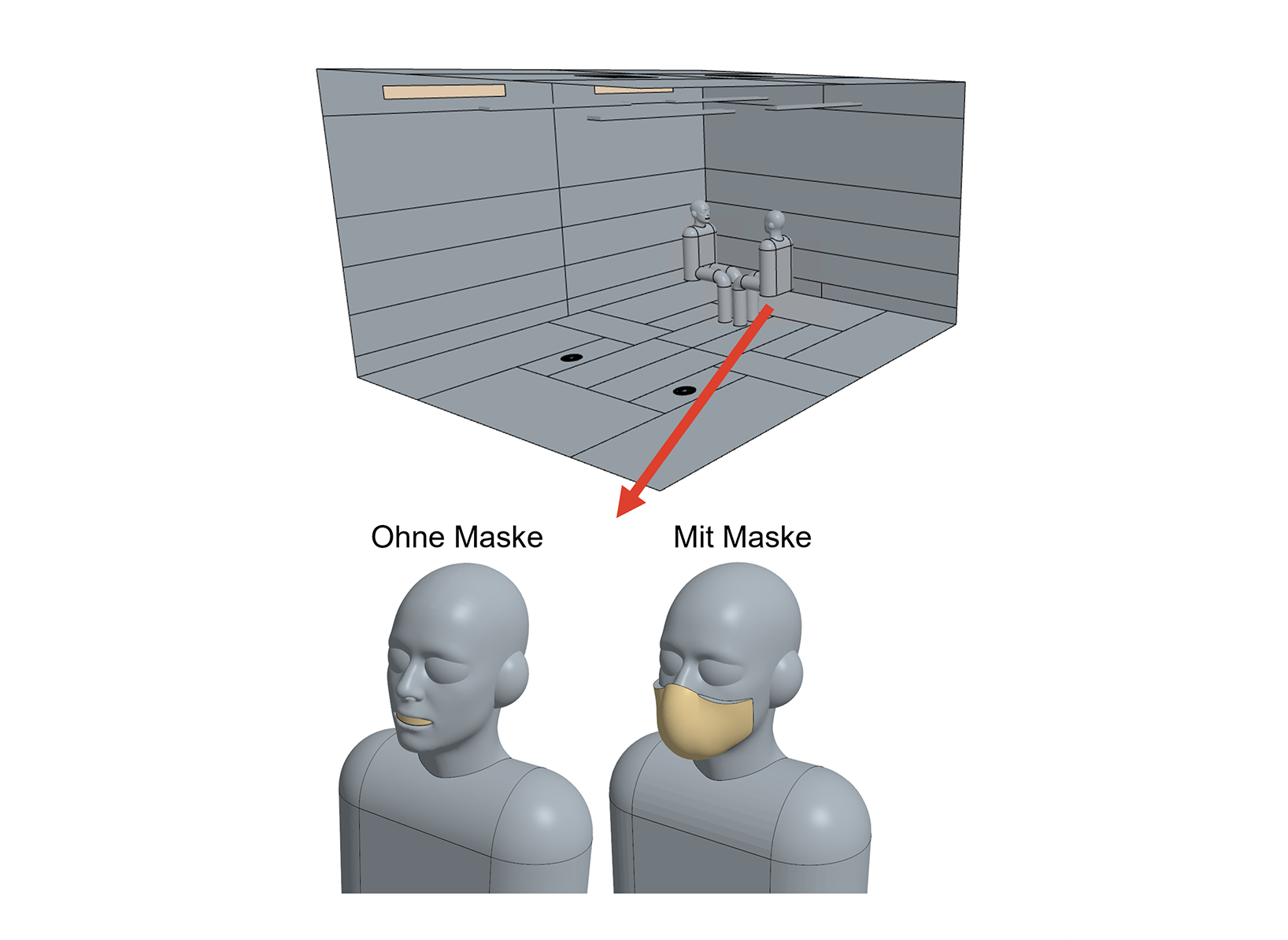 Geometry model of the CoSIE Lab test room with manikins and floor diffusers.
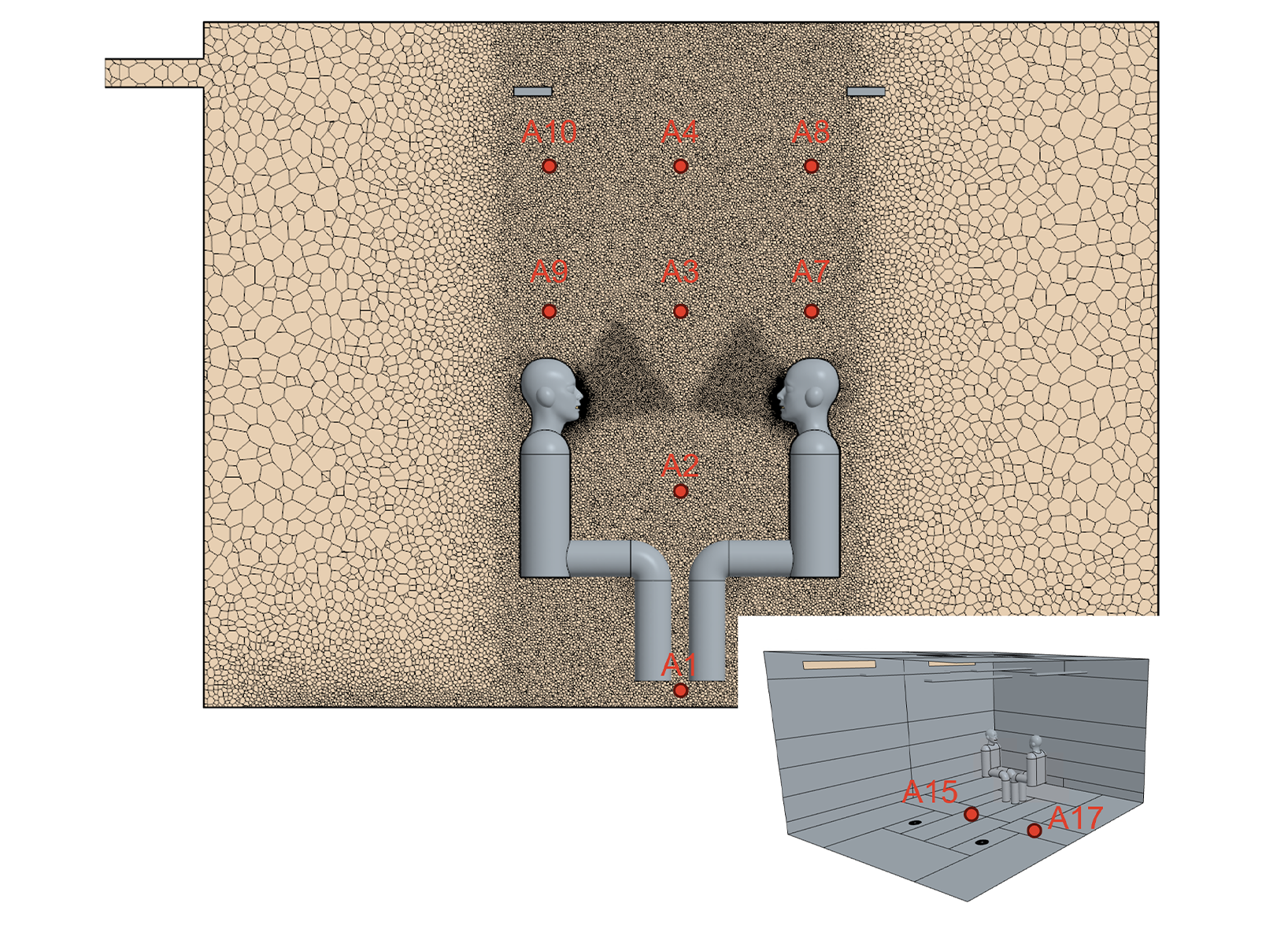 Local discretizations of the mesh for the simulation case without a mask.
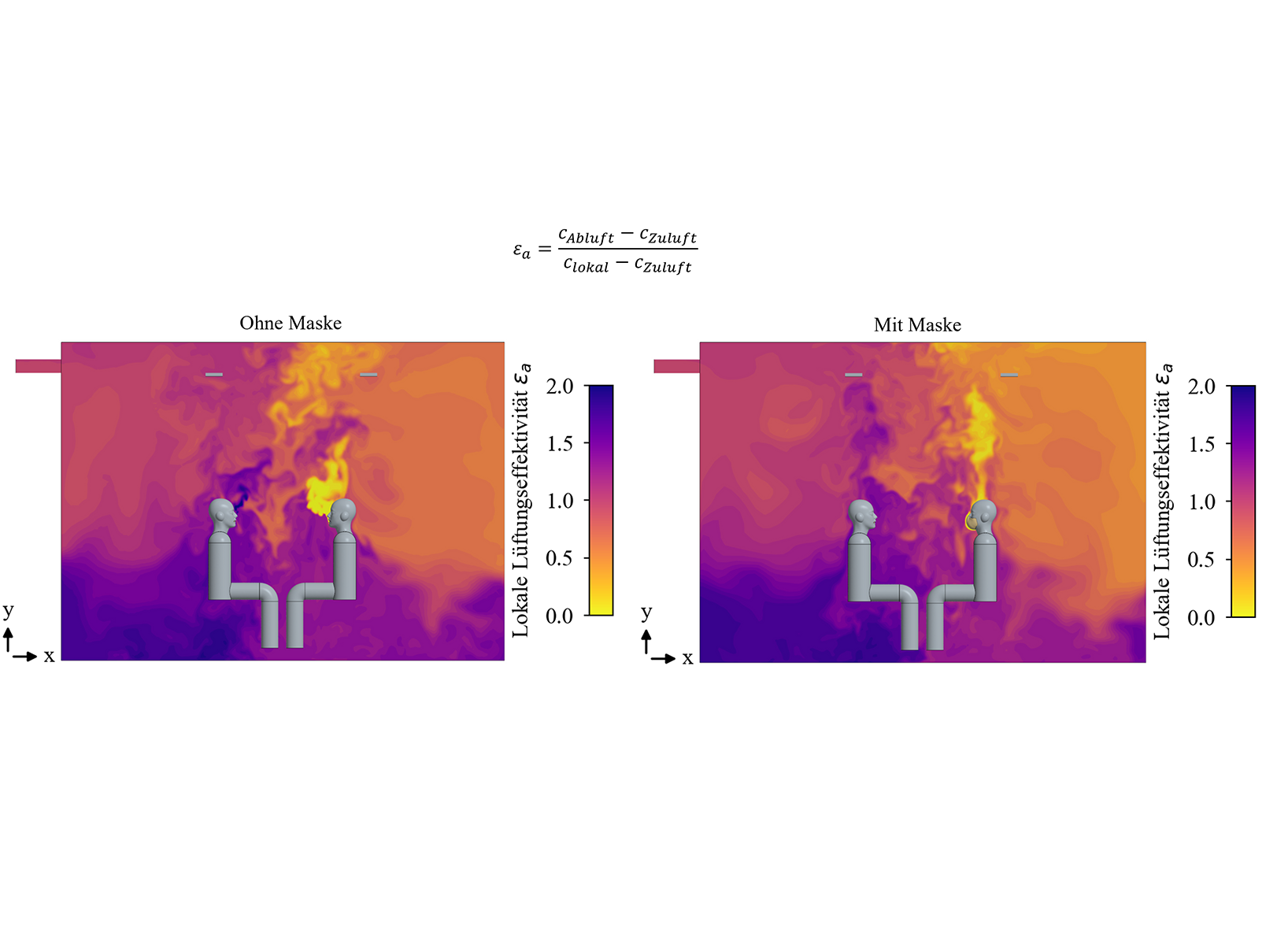 Comparison of local ventilation effectiveness without (left) and with a mask (right) on the source manikin.
People spend most of their time indoors, where respiratory pathogens such as SARS-CoV-2 are predominantly transmitted through the air. Building planners and operators therefore need methods that predict the infection risk in a given room and quantify how much measures such as ventilation and mouth-nose coverings reduce it.
The aim of the research project is to validate the numerical prediction of airborne transmission of exhaled breath between occupants in a mechanically ventilated room, with particular focus on the protective effect of respiratory masks. The local ventilation effectiveness in the breathing zone of a receiving occupant serves as the central quantity of interest, since it directly enters subsequent infection risk models. Experimental tracer-gas measurements (see publications) provide validation data at discrete sensor positions, while CFD simulations resolve the full three-dimensional and transient concentration field.
Project Details
Project term
December 21, 2025–September 30, 2026
Affiliations
RWTH Aachen University
Institute
Institute for Energy Efficient Buildings and Indoor Climate
Principal Investigator
Methods
The transient flow simulations are performed using the commercial software Simcenter Star-CCM+. A Large Eddy Simulation with the WALE subgrid-scale model is employed throughout. The validation follows a two-stage process: first, the thermal buoyancy flow around a heated thermal manikin is validated against thermoanemometer and infrared measurements; second, the tracer-gas distribution between a source and a receiver manikin is validated against CO2 sensor measurements at 14 positions, evaluated in terms of the local ventilation effectiveness (LVE). Two cases are simulated for the second stage: one without a mask and one with a mask on the source manikin. Due to the long residence time required for the tracer gas to reach a representative spatial distribution, a simulated physical time of 3000 s at a time step of 0.005 s is required for each case.
Results
The thermal buoyancy validation shows good agreement between simulation and measurement for flow velocity, air temperature, and manikin surface temperature.
For the tracer-gas validation, the local ventilation effectiveness at the 14 sensor positions is reproduced with an RMSE of 0.272 for the unmasked case and 0.187 for the masked case, indicating that the mask-induced blocking effect on the exhalation jet is captured with improved accuracy relative to the unmasked baseline.
Both simulations matched the measured vertical LVE profiles in the room and between the manikins well. With a mask, the simulation also reproduced the elevated LVE of about 1.4 at the recipient. Deviations concentrated in the breathing zone of the source. Without a mask, the simulation underestimated the mixing of exhaled air there, predicting local LVE values of about 0.5 where measurements showed values near 1. It also overestimated the recipient’s LVE (about 1.4 versus a measured 1.0).
Discussion
The two-stage validation strategy demonstrates that the coupled LES approach reproduces both the underlying thermal flow field and the resulting tracer-gas distribution with acceptable accuracy for infection-risk-relevant quantities. The long required simulation time of 3000 s per case, driven by the slow approach to a representative room-scale concentration field, results in a substantial computational cost on the CLAIX-2023 HPC system. The improved agreement for the masked case suggests that the redirected, lower-momentum exhalation flow is comparably or more robustly captured by the LES than the unobstructed jet of the unmasked case.
Next steps could include a refined mouth and throat geometry, alternative inflow conditions, and a sensitivity study on exhaled-air density.
Additional Project Information
DFG classification: 404-03 Fluid Mechanics
Software: Star-CCM+
Cluster: CLAIX
Publications
Combined effects of face mask blocking, filtration, and ventilation strategy on exhaled air transmission and infection risk,
Dennis Derwein, Filip Paszek, Kai Rewitz, Dirk Müller,
https://doi.org/10.1016/j.buildenv.2026.115206, November 2026