Project
Parallel Finite Element Methods for Complex Flows of Complex Fluids
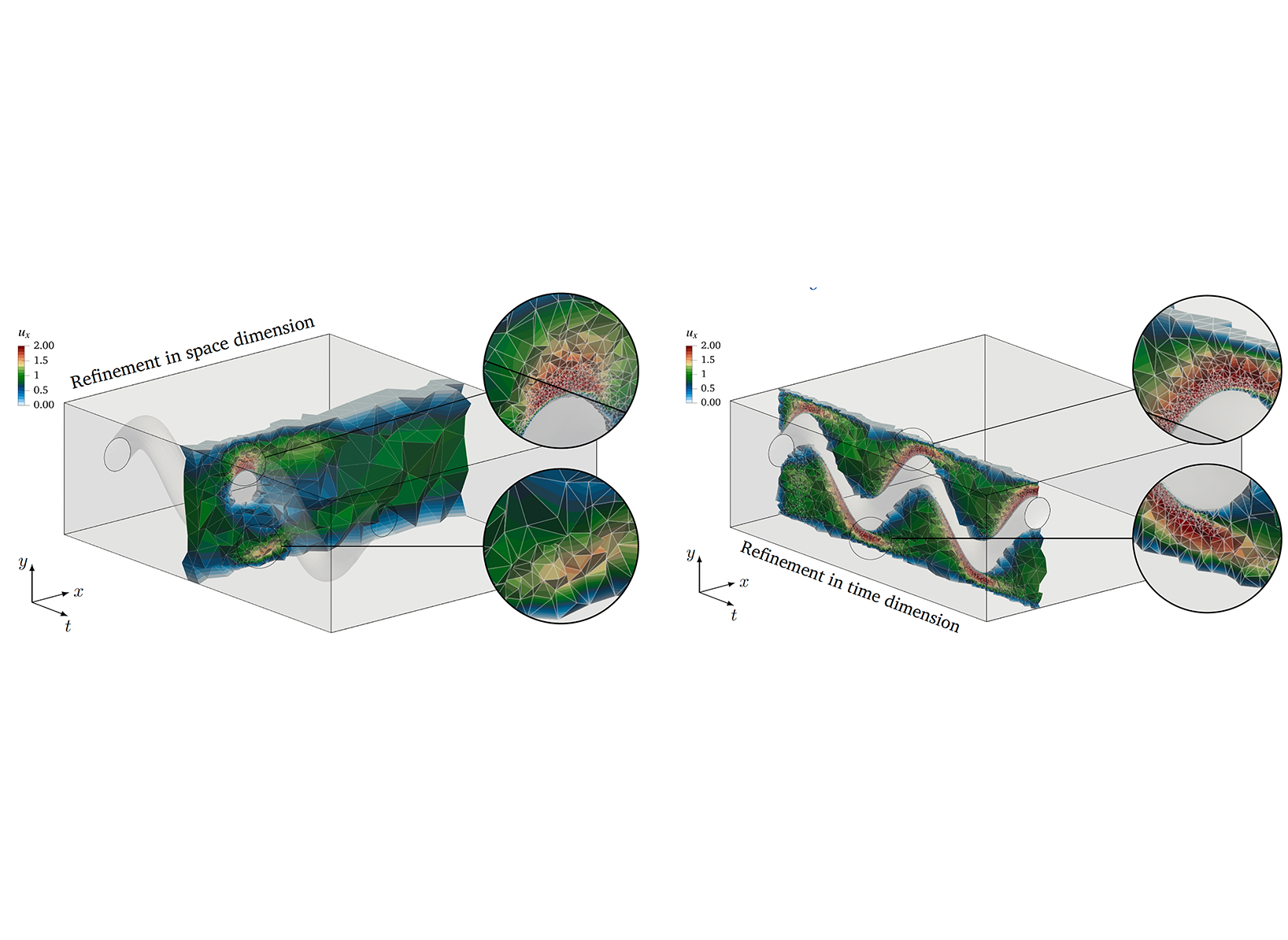 CFD analysis of a flow around an oscillating cylinder using an adaptive space-time mesh
 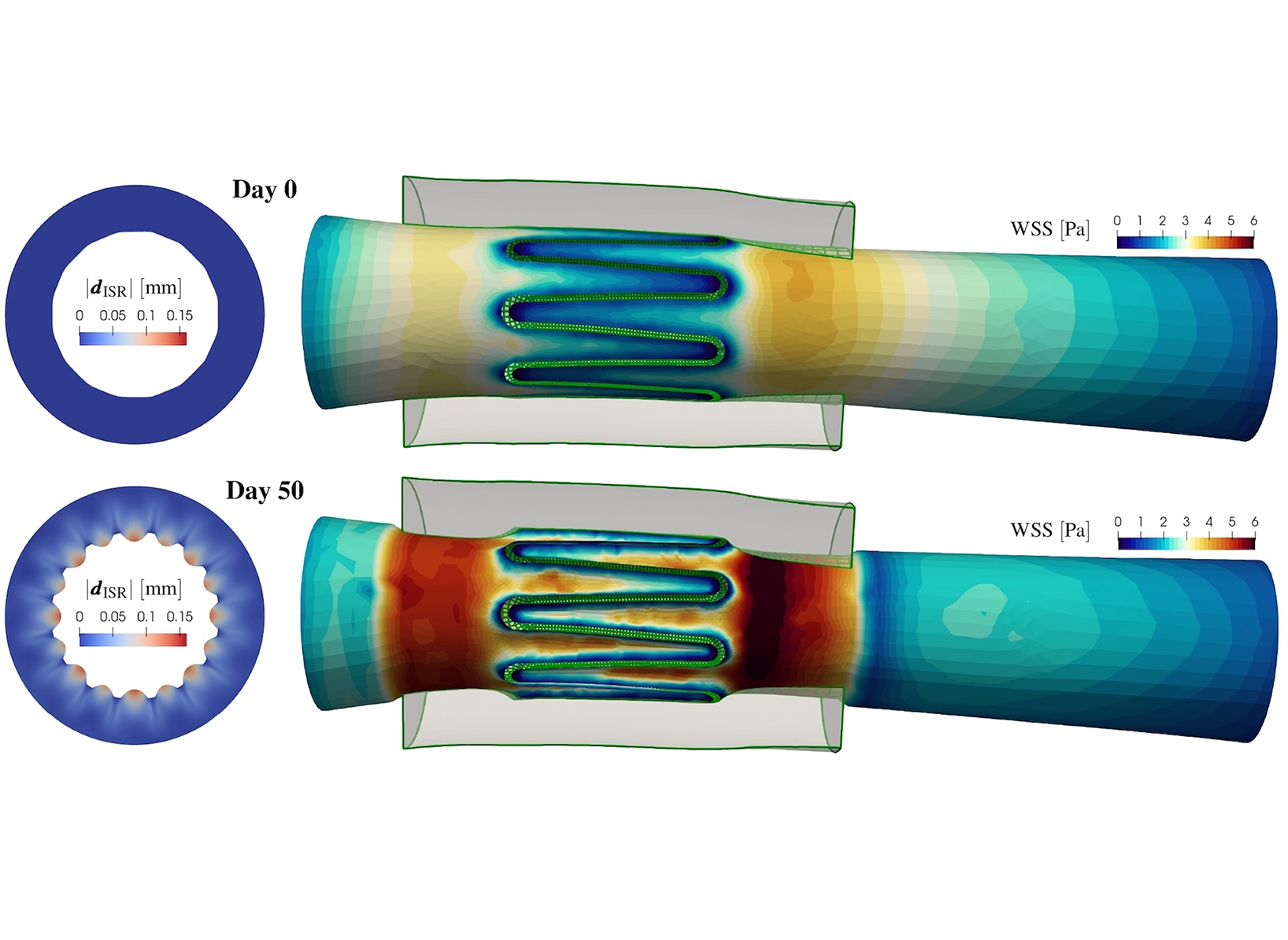 Results for a patient-specific artery with a single-crown stent
 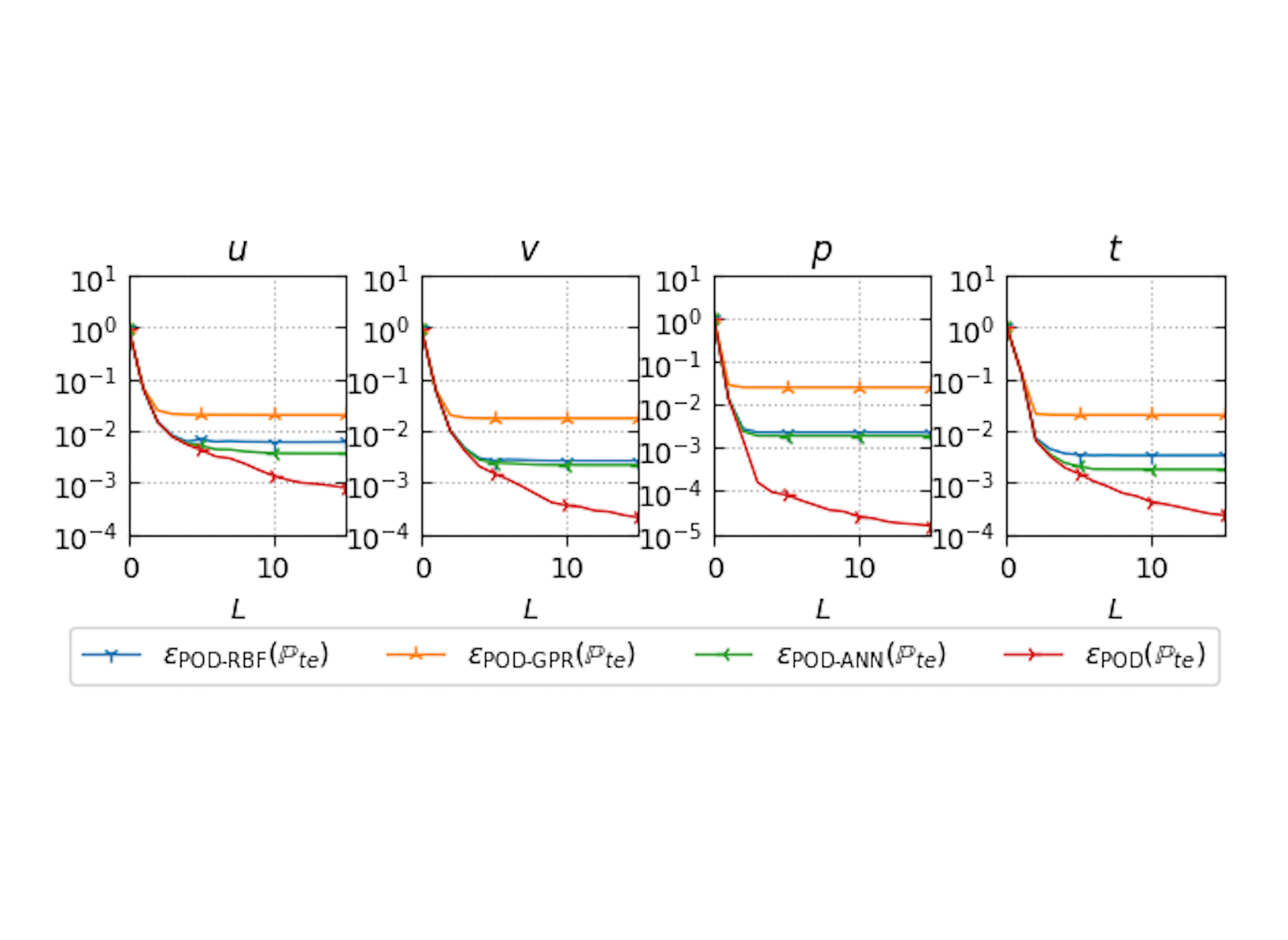 Velocity (u and v), pressure (p), and temperature (t) projection and prediction errors by regression method with respect to the number of basis functions (L) used for the cavity filling simulation
 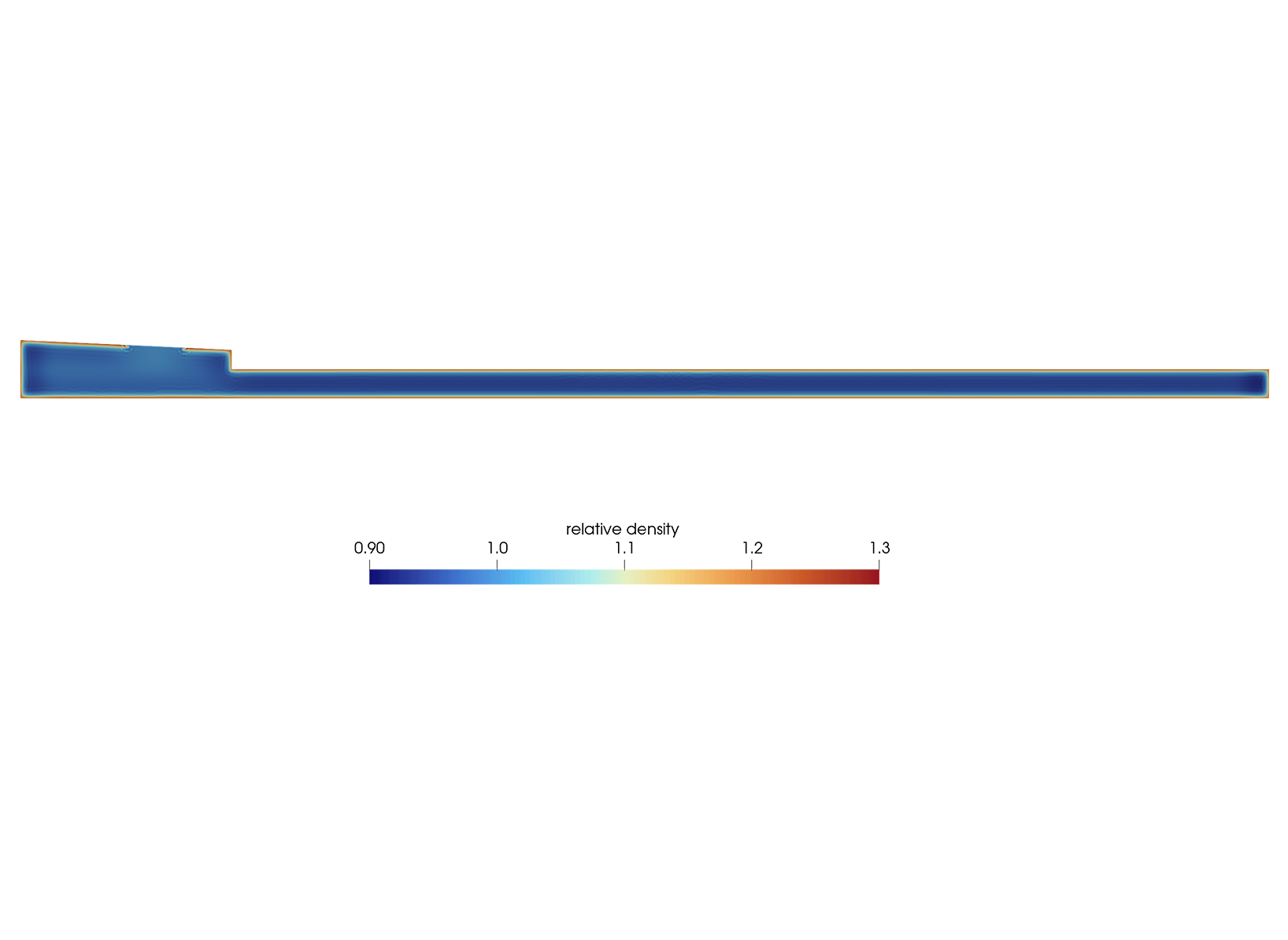 Relative density in 2D injection molding packing simulation
 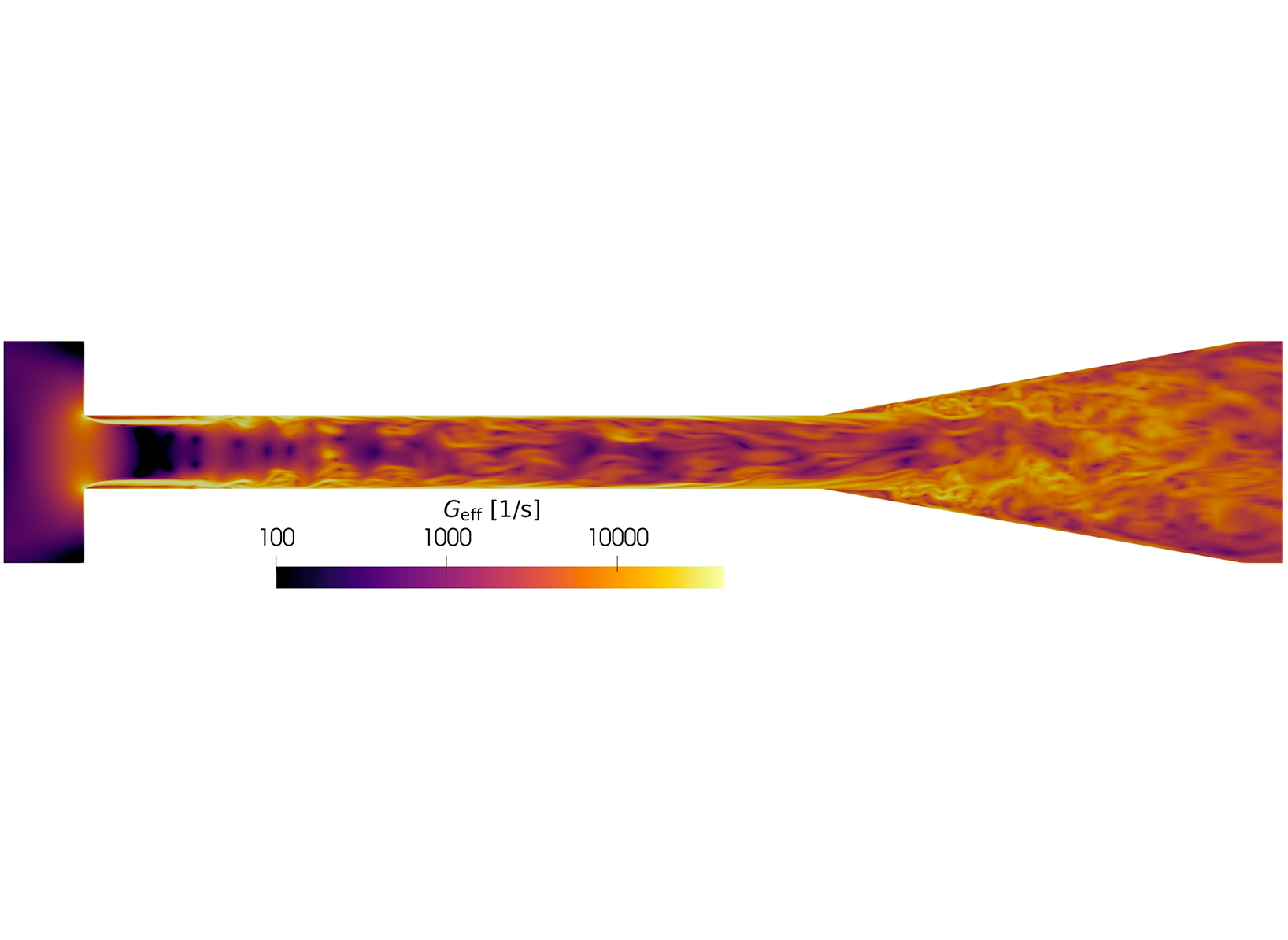 CFD and hemolysis simulations of the FDA benchmark nozzle geometry: instantaneous fluid shear rate
 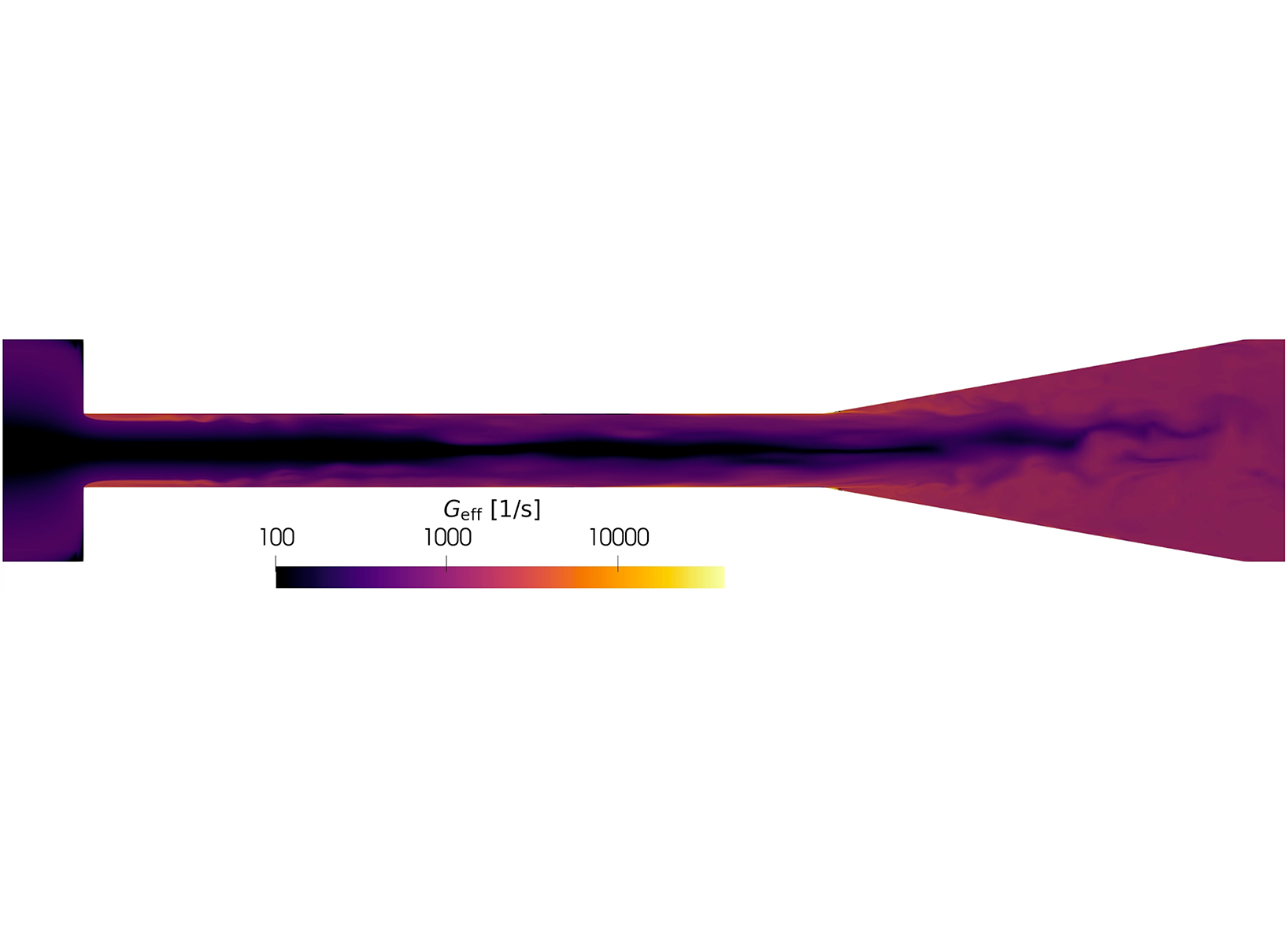 CFD and hemolysis simulations of the FDA benchmark nozzle geometry: effective shear rate for red blood cell damage
 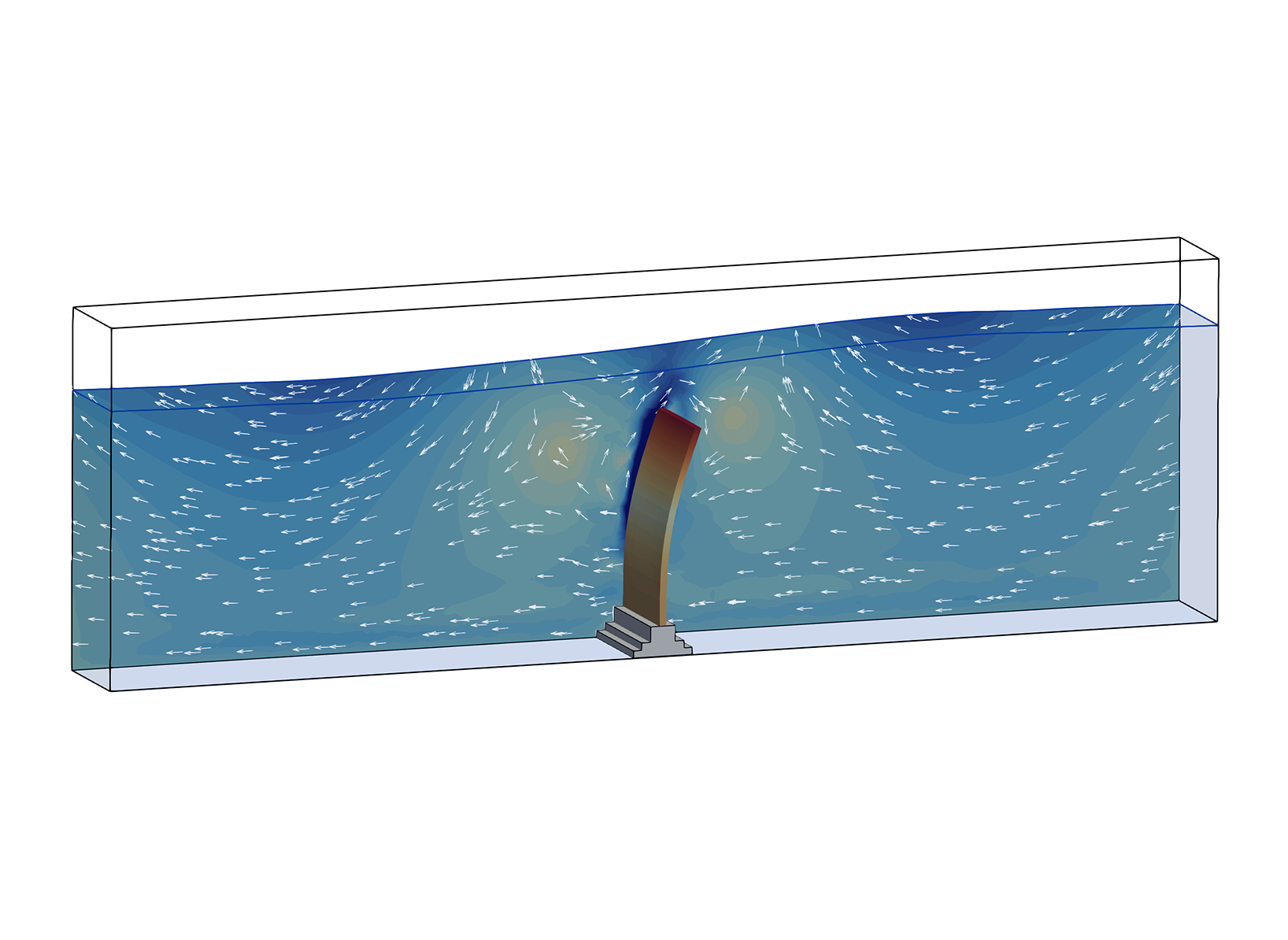 Numerical simulation of a rectangular sloshing tank with a flexible clamped baffle
 The objective of this ongoing project is the continuous development and advancement of effective simulation methods for unsteady fluid flow problems and their application to real-life engineering problems. Common ground for all sub-projects presented below is our in-house parallel finite element solver for multi-physics problems, including compressible and incompressible Navier-Stokes flows, linear elastic materials, non-Newtonian and viscoelastic fluids, as well as transport problems. These transport problems encompass scalar advection (temperature, concentration) and tensor advection (red blood cell morphology, fiber orientation). In addition, we are working with physics-informed neural networks (PINNs) to predict flow fields. These predictions are supplemented by data produced with high-fidelity finite element simulations.
Project Details
Project term
May 1, 2025–April 30, 2026
Affiliations
RWTH Aachen University
Institute
Chair for Computational Analysis of Technical Systems
Principal Investigator
Methods
The in-house FE solver XNS is written in Fortran and C and utilizes an MPI parallelized framework. The machine learning applications are employed in two in-house frameworks. One of them is built up on the Deep-XDE python package and leverages automatic differentiation integrated in TensorFlow to evaluate differential operators. In the PINN algorithm, the residuals of both the governing partial differential equations (PDEs) and boundary constraints are incorporated into the loss function which is minimized during the training of the neural network. For more complex problems, we use a domain decomposition approach, where two or more neural networks are trained in parallel. The second framework is developed from scratch, using functionality provided by PyTorch to train the neural networks.
Results
Results
During the last allocated project period, substantial progress was achieved across all ten sub-projects. A coupled multiphysics model for in-stent restenosis was developed and applied to a patient-specific coronary artery, integrating cell dynamics, growth mechanics, hemodynamics, and drug elution. In injection molding process, space-time adaptive two-phase flow simulations were successfully benchmarked against COMSOL in 2D and experimentally validated in 3D, while short-fiber reinforced injection molding was advanced using a simplex space-time finite element method with adaptive mesh refinement (AMR) to improve fiber orientation predictions. Additionally, our work identified the key parameters governing the printing force in fused deposition modeling-based 4D printing. A partitioned fluid-structure interaction (FSI) framework coupling the fluid solver XNS with a solid solver was established for the seismic analysis of storage tanks. A unified fluid-structure-contact interaction workflow, supported by a newly developed 4D space-time mesher, was demonstrated for aluminum sheet rolling. In addition, a new Eulerian hemolysis model was developed and validated, and a novel approach to incorporating viscoelastic fluid models was proposed. For FSI in plastics profile extrusion dies, adaptive finite element discretizations for solids and simplex space-time meshes for incompressible Navier-Stokes flow were implemented and tested in XNS. A new workflow featuring automatic AMR based on the oil-gas interface was developed, extended to moving domains, and equipped with error estimators derived from the fluid solution. Finally, Physics-Informed Neural Networks were benchmarked as surrogate models for stirred-tank reactors, with their data efficiency evaluated against classical supervised methods.
Discussion
We expect to obtain a patient‑specific, quasi‑steady in‑silico tool that couples restenosis growth, arterial mechanics, hemodynamics and drug‑elution to optimise drug‑eluting stent implantation.
Space‑time adaptive grids will deliver fast, high‑precision predictions of the entire injection‑molding process—including polymer solidification and warpage—for industrial optimisation.
Thermoviscoelastic melt modelling will be used to design and optimise nozzles for 4D‑printing of shape‑memory polymers, improving stress development and shape‑morphing.
Scalable space‑time adaptive discretisations will enable large‑scale 3D fibre‑reinforced moulding simulations that simultaneously solve flow, level‑set, temperature and fibre‑orientation equations with error control.
A validated fluid‑structure‑interaction solver will reproduce free‑surface experiments and demonstrate robustness for large deformations such as sloshing in soft‑walled tanks.
A full 3D fluid‑structure‑contact framework will analyse lubricant‑alloy combinations in skin‑pass rolling, incorporating grid‑convergence studies and topology‑changing 4D grids.
High‑fidelity CFD combined with a practical hemolysis model will predict red‑blood‑cell damage in advanced biomedical devices, offering design‑level hemocompatibility insights.
Adaptive finite‑element methods on time‑continuous simplex space‑time meshes will provide anisotropic refinement that treats space and time uniformly, eliminating separate remeshing steps.
Adaptive mesh‑refinement workflows will be scaled to realistic 3D piston‑ring‑pack gas‑flow cases, supplying performance models for efficient industrial analysis.
Physics‑informed neural networks will be extended to turbulent 3D stirred‑tank reactors, integrating data‑driven RANS closures and quantifying their data‑efficiency versus conventional supervised networks.
Additional Project Information
DFG classification: 402-02 Mechanics
Software: XNS, pINS
Cluster: CLAIX
Publications
In-silico analysis of hemodynamic indicators in idealized stented coronary arteries for varying stent indentation,
A. M. Ranno, K. Manjunatha, A. Glitz, N. Schaaps, S. Reese, F. Vogt, M. Behr,
https://dx.doi.org/10.1080/10255842.2024.2382819, July 2024
On the Significance of Flow Vorticity for Hemolysis Modeling,
N. Dirkes, M. Behr,
https://dx.doi.org/10.14311/TPFM.2025.008, 2025
Addressing a Major Bottleneck in Computational Mechanics with Simplex Space-Time Finite Elements: Application to Free-Surface Flows,
Norbert Hosters, Blanca Ferrer-Fabón, Moritz Billen, Marek Behr,
https://dx.doi.org/10.1007/978-3-031-93213-7_13, 2025
Experimental Investigation of the Applicability of the Stress‐Based and Strain‐Based Hemolysis Models for Short‐Term Stress Peaks Typical for Rotary Blood Pumps,
Michael Lommel, Vera Charlotte Lommel, Henri Wolff, Nico Dirkes, Katharina Vellguth, Marek Behr, Ulrich Kertzscher,
https://dx.doi.org/10.1111/aor.15002, April 2025
Quantifying data needs in surrogate modeling for flow fields in two-dimensional stirred tanks with physics-informed neural networks,
Veronika Trávníková, Eric von Lieres, Marek Behr,
https://dx.doi.org/10.1063/5.0291054, November 2025
A computational model of coronary arteries with in-stent restenosis coupling hemodynamics and pharmacokinetics with growth mechanics,
Anna Ranno, Kiran Manjunatha, Thore Koritzius, Ivo Steinbrecher, Norbert Hosters, Maximilian Nachtsheim, Pakhwan Nilcham, Nicole Schaaps, Anne Turoni-Glitz, Janina Datz, Alexander Popp, Kevin Linka, Felix Vogt, Marek Behr,
https://dx.doi.org/10.1038/s41598-025-22291-w, November 2025
Tensorial models in numerical simulations of hemodynamics and hemolysis,
Nico Dirkes, Adélia Sequeira, Marek Behr, and Tomáš Bodnár, 2026
Adaptive Refinement for Multi-Phase Flow Simulation on Moving Domains,
Patrick Antony, Blanca Ferrer Fabón, Norbert Hosters & Marek Behr,
https://dx.doi.org/10.1007/978-3-032-16253-3_1, 2026
A Practical Computational Hemolysis Model Incorporating Biophysical Properties of the Red Blood Cell Membrane,
Niko Dirkes, Marek Behr,
https://dx.doi.org/10.48550/arXiv.2601.19994, January 2026
An Ising machine formulation for design updates in topology optimization of flow channels,
Yudai Suzuki, Shiori Aoki, Fabian Key, Katsuhiro Endo, Yoshiki Matsuda, Shu Tanaka, Marek Behr, Mayu Muramatsu,
https://dx.doi.org/10.1007/s00366-025-02265-2, January 2026
Printing force analysis in FDM-based 4D printing of singular lines: A numerical and experimental study,
Ferdinand Cerbe, Felipe A. González, Michael Sinapius, Marek Behr, Stefanie Elgeti,
https://dx.doi.org/10.1016/j.addma.2026.105108, February 2026
Two‐Phase Flow Simulations for Injection Molding Applications: Comparison between COMSOL Multiphysics and XNS In‐House Solver,
Blanca Ferrer Fabón, Jonathan Alms, Marek Behr, Christian Hopmann,
https://dx.doi.org/10.1002/pamm.70147, May 2026
Numerical optimization of planar nozzle shapes for fused deposition modeling,
Steffen Tillmann, Felipe A. González, Stefanie Elgeti,
https://dx.doi.org/10.1108/HFF-02-2026-0141, May 2026
Thesis:
Advances and Applications in High-Definition Simulation of Packed Bed Liquid Chromatography,
Jayghosh Subodh Rao,
PhD thesis, 2025
Modeling and simulation of blood damage in medical devices,
Stefan Thomas Haßsler,
PhD thesis, 2025