This summer, Christian Gutschka started his journey in NHR4ES by joining the NHR Graduate School in the fifth cohort. Under the supervision of Professor Jochen Schneider, he began his doctoral research at RWTH Aachen University and has also joined the SDL Materials Design at NHR4CES. This interview continues our previous conversation „From Vienna to Aachen: Christian Gutschka joins the NHR Graduate School“ from June. Today, he tells us what has changed since then, what experiences and challenges he encountered and what he is looking forward to.
Since our first interview, what has changed most in your research journey at NHR4CES?
I have become more familiar with the research environment at RWTH Aachen and have connected more closely with colleagues in Prof. Schneider’s group. I have also started using the HPC resources at RWTH Aachen more actively, which has become an important part of my computational work.
What has been the biggest scientific challenge you have encountered in your doctoral research so far, and how did you approach it?
A key challenge has been transferring theoretical concepts from the literature to a specific research problem. This often requires careful implementation, testing, and validation. Breaking larger questions into smaller steps has been the most effective way to make progress.
How has working with high-performance computing changed the way you approach your research questions?
HPC enables a more exploratory approach by making it possible to test different methods and investigate larger or more complex systems. In materials science, it expands the range of questions that can be addressed and supports the connection between fundamental simulations and practical applications.
Since joining the NHR Graduate School, which experience, collaboration, or event has influenced you most as a young researcher?
The NHR4CES team event was especially valuable because it provided a welcoming setting to meet researchers from different fields. The informal programme, particularly the bowling event, made it easy to connect with people beyond one’s own research area.
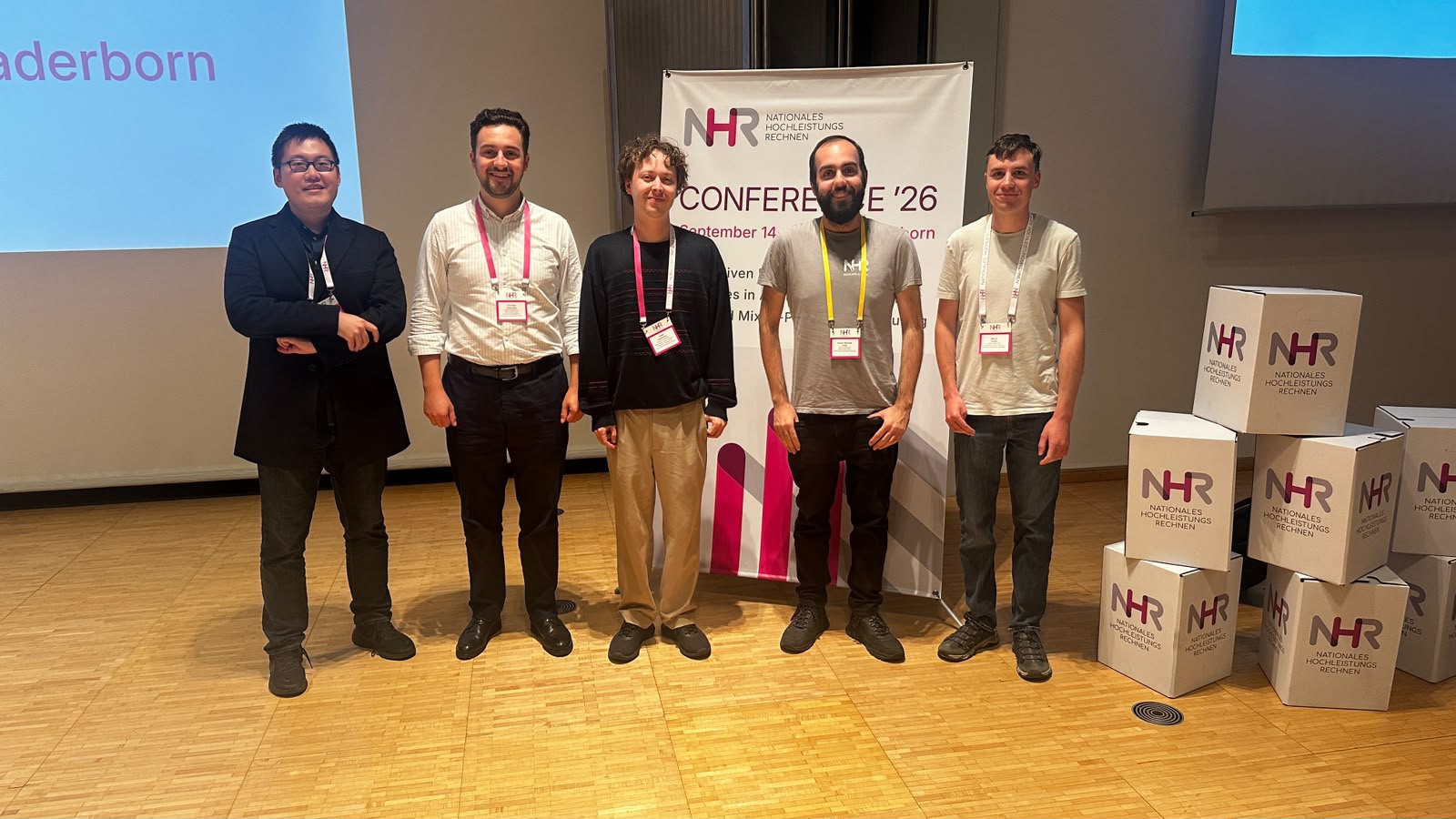
You attended the NHR Conference in Paderborn. What did you like the most and what are your first impressions of the NHR community?
The conference location at the Heinz Nixdorf MuseumsForum was a highlight, as the museum offered an interesting perspective on the development from early calculating machines to modern computing. The NHR community appeared very diverse and collaborative, bringing together researchers from many disciplines through a shared interest in HPC.
You came to Aachen from Vienna. Looking back, what surprised you most about living and working in Aachen?
Compared with other European cities, life in Aachen feels somewhat more relaxed, especially regarding the density of people and public transport. I was also surprised by how warm the summers in Aachen can become.
What were your first impressions of NHR4CES?
Even before officially starting, I was invited to the annual NHR4CES team event. It was a fantastic introduction to the group and gave me the opportunity to meet many colleagues in a relaxed setting. Activities like bowling and the shared dinner created a welcoming atmosphere and made it easy to feel part of the team from day one.
Where do you see the greatest potential for combining high-performance computing, artificial intelligence, and materials science in the coming years?
Machine-learning interatomic potentials are particularly promising because they can combine high accuracy with improved computational efficiency. They may enable simulations of larger systems and longer time scales, while HPC remains essential for training, validating, and applying these models.
If we speak again a year from now, what would you ideally like to have achieved – both in your research and also personally?
I would like to have made substantial progress on my doctoral project and ideally contributed to a scientific publication. Personally, I hope to work more independently and to further strengthen the collaboration with experimental researchers in Prof. Schneider’s group.
Thank you Christian for sharing these experiences with us! We hope to hear from you again in the next update, and until then, we wish you all the best.