We are excited to share a new collaboration between (former) researchers from NHR4CES: An exploration of contrastive self-supervised learning for reconstructed atom probe tomography data – https://doi.org/10.1088/2632-2153/ae5c57.
Authors: Janis A Sälker, Marcus Hans, Jochen M. Schneider, and Raheleh Hadian
In this work, the authors investigate contrastive self-supervised learning alongside a graph neural network to derive meaningful representations of 3D atomic environments in APT data.
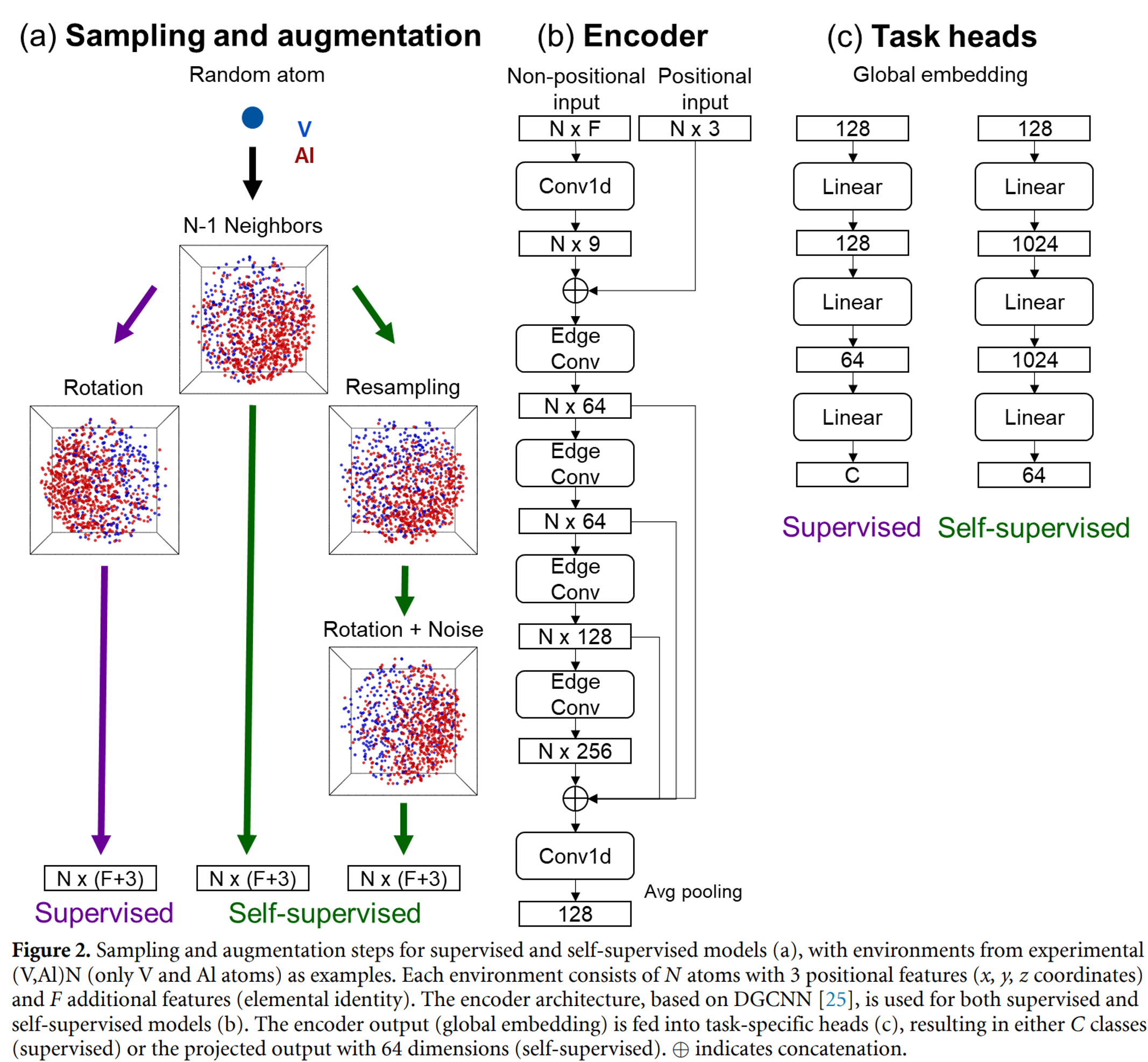
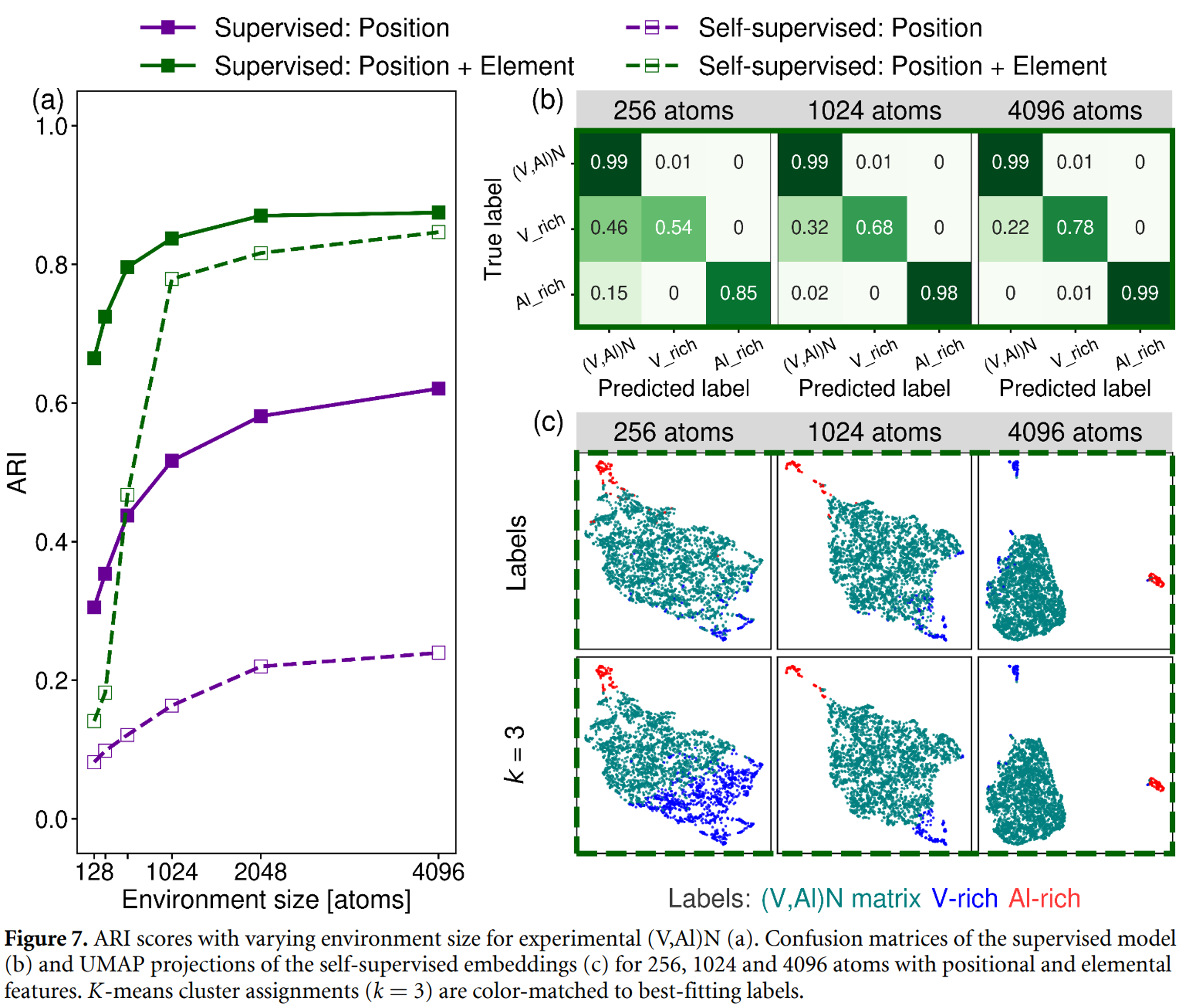
Atom probe tomography (APT) enables spatially resolved chemical analysis at the nanometer scale, generating large 3D atomic datasets. Segmentation of subvolumes with similar composition and properties is crucial for data interpretation, but is often hindered by measurement aberrations and user bias. By employing clustering to group the learned representations, this approach requires no user-supplied labels, supporting an exploratory analysis. Using both experimental and artificial APT datasets, the authors systematically investigate the influence of input data variations on model performance. Specifically, they vary per-atom features, size of atomic environments, and APT measurement aberrations, namely positional inaccuracies and limited detection efficiency. To assess capabilities, the self-supervised workflow is benchmarked against a fully supervised model. The team demonstrates that, given suitably sized environments and expressive per-atom features, both approaches achieve closely matched clustering and classification performance. The supervised model is less sensitive to hyperparameters, whereas the self-supervised workflow, guided by label-free metrics, mitigates user bias.
For this paper, NHR4CES’s HPC infrastructure CLAIX was used! Have a look at CLAIX to see how you can use our High Performance Computer to advance your own science.
Read the paper: https://doi.org/10.1088/2632-2153/ae5c57.