SDL Energy Conversion presents
Numerical Methods for Combustion
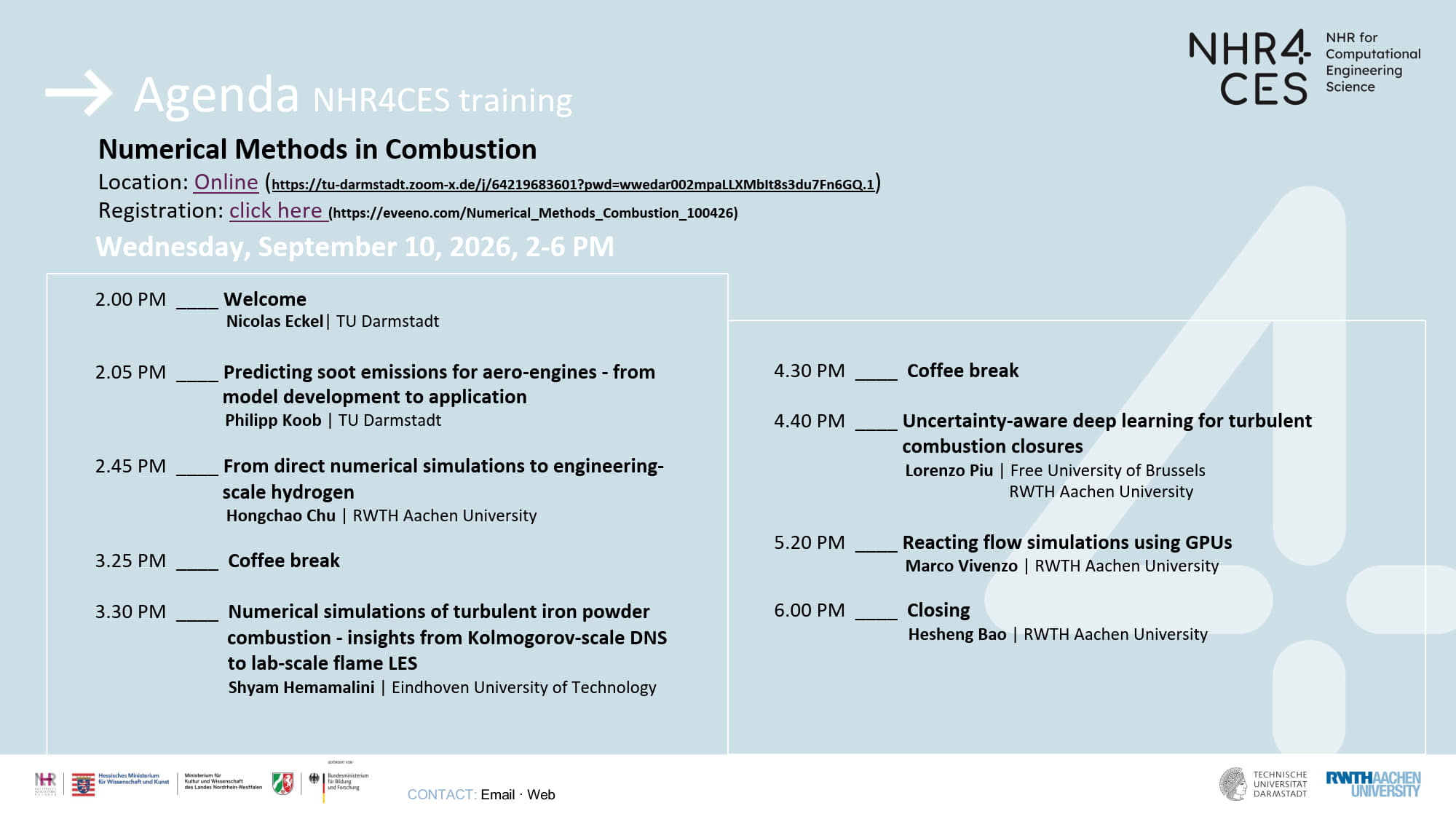
Date: September 10, 02.00 pm - 06.00 pm, 2026; Format: online
Short abstract:
In the face of climate change and its undeniable threats to humanity, the urgency for transitioning to CO2-free or carbon-neutral energy systems is paramount. While the future of energy conversion will be largely dominated by renewable sources, such as wind and solar power, combustion technologies will continue to play a crucial role in meeting the world’s growing energy demands, especially in the near term. The expected rise in alternative fuels—such as biofuels, e-fuels, and green hydrogen—demands a deeper understanding of combustion processes to ensure cleaner, safer, and more efficient energy generation. Accurately simulating combustion, however, is a formidable challenge due to its inherently multi-physics nature, involving complex interactions between turbulence, chemistry, and multi-species flows.
This workshop will focus on advanced numerical methods for modeling and simulating combustion phenomena in high-performance computing environments. Participants will gain insights into cutting-edge techniques and numerical methods, covering topics such as combustion closure modeling, load-balancing techniques, soot formation, and more. The workshop aims to gather different research groups, providing a venue to exchange new ideas, discuss challenges, and expose this new research field to a broader community.
Language: English
Capacity: 300
Required skills: intermediate
Further information: This training is given twice a year, presenting our latest research, to provide sufficient and up-to-date insights regarding the combustion modeling to the audience.
All about our speakers
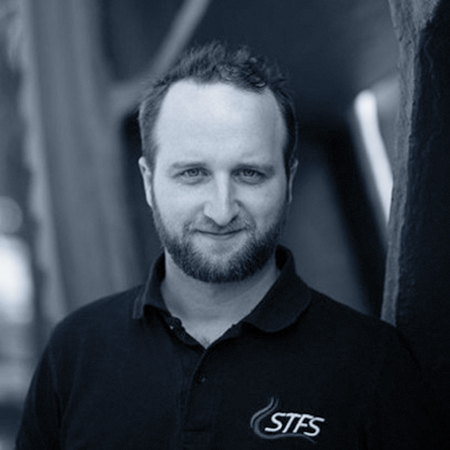
Dr. Philipp Koob
… is a Post-Doc at the Institute for Reactive Thermo-Fluid Systems (STFS) at Technical University Darmstadt with Prof. Christian Hasse. His presentation gives an insight into the challenges of simulating soot emissions of real aero-engine combustors. An advanced soot model, based on the method of moments, is combined with LES to investigate the strong interactions between mixture formation, the local thermo-chemical state, and residence times inside an aero-engine combustion chamber.
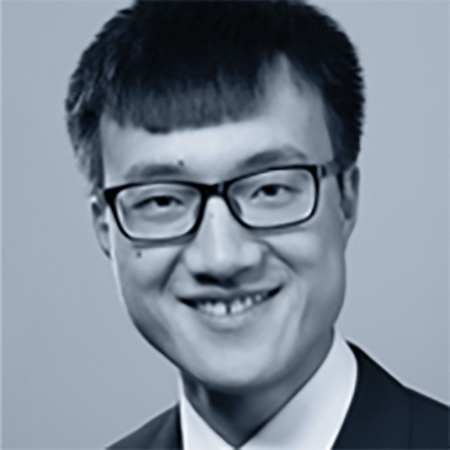
Dr. Hongchao Chu
… is a Research Group Leader at the Institute for Combustion Technology, RWTH Aachen University. He received his Ph.D. from RWTH Aachen University in 2023 and is currently leading research activities in the Reactive Flow Applications and Multiphase Flows groups. His research has received international recognition, including a Distinguished Paper Award at the International Symposium on Combustion and Bernard Lewis Fellowship.

Shyam Hemamalini
… is a PhD candidate with the Power&Flow group in the Department of Mechanical Engineering at Eindhoven University of Technology. His PhD is supervised by Dr. XiaoCheng Mi from the same group. His work focuses on developing solvers and running CFD simulations of turbulent iron powder combustion using Euler-Lagrange techniques in DNS and LES. Prior to his PhD work, Shyam obtained his MSc degree from Delft University of Technology in the subtopic of Energy, Flow, and Process.
Presentation: Iron powders are a novel energy storage technology that is carbon-free and recyclable. Large-scale iron powder reactors of today face challenges of combustion efficiency and ignition failure. Can this be explained from the perspective of flow-particle interaction? The heterogeneous non-volatile combustion mode of iron powders is unique, and the flow in a combustor is hence characterized as particle-laden and turbulent. How is the combustion process of iron powders affected by the complex turbulent flow and flow-particle interactions? This talk presents a first-of-its-kind analysis of this process from idealized DNS at the Kolmogorov scale all the way up to modeling a realistic lab-scale burner using LES, using state-of-the-art CFD and chemistry techniques to tackle an emergent phenomenon in a complex multiphase reacting system.
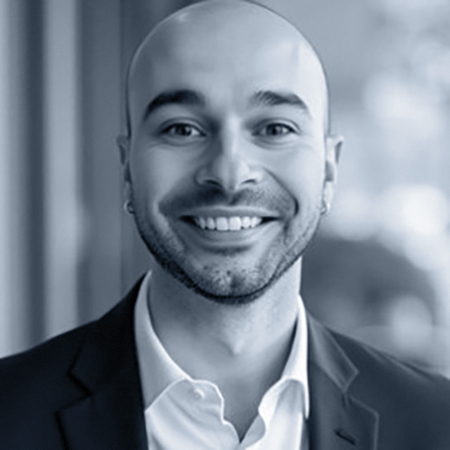
Lorenzo Piu
… is a researcher in computational fluid dynamics and combustion, specializing in the high-fidelity simulation of turbulent reacting flows. His work centers on subgrid-scale modeling for large-eddy simulation (LES), with a particular focus on applying machine learning to combustion closure problems. He currently works across the modeling pipeline, from the analysis of direct numerical simulations (DNS) data to neural-network-based subgrid models. He is affiliated with the Aero-Thermo-Mechanics Laboratory at ULB (Brussels) and the Institute for Combustion Technology at RWTH Aachen, under the supervision of Professors Alessandro Parente and Heinz Pitsch. He received his BSc degree in Aerospace Engineering in 2020 and his MSc degree in Aerospace Engineering in 2023, both from the Polytechnic University of Turin. He completed his master’s thesis at the von Karman Institute for Fluid Dynamics, where he worked on Computational Fluid Dynamics (CFD) of multiphase capillary heat exchangers for satellites.

Marco Vivenzo
… is a research assistant at the Institute for Combustion Technology at the RWTH Aachen University. He received his Master of Science in Mechanical Engineering after graduating from the University of Naples Federico II. His main research interests are in the fields of combustion modeling in large-eddy simulations (LES) and high-performance computing. Since 2021, Marco has been a member of the SDL Energy Conversion for the National High Performance Computing Center for Computational Engineering Sciences (NHR4CES).
Contact person

Marco Vivenzo
RWTH Aachen University
Hesheng Bao
RWTH Aachen University
Nicolas Eckel
TU Darmstadt