Professor Christian Hasse, Principal Investigator in our Simulation and Data Lab Energy Conversion receives the Gottfried Wilhelm Leibniz Prize. The award, granted by the German Research Foundation (DFG), is worth 2.5 million euros and is considered the most important and most highly endowed German research prize. The DFG is thus recognizing Hasse’s achievements in the field of reactive thermofluid dynamics. His work opens up new knowledge-based paths for a climate-neutral energy future.
In his work, Christian Hasse opens new knowledge-based pathways toward a carbon-neutral energy future – a decisive contribution to addressing the global climate crisis and advancing the decarbonisation of energy systems. Through pioneering mathematical models and advanced numerical methods for high-resolution simulations of three-dimensional, unsteady, and reactive flows on supercomputers, he sets benchmarks. His research combines thermofluid dynamics with high-performance computing, materials science, and chemistry, exploring uncharted scientific territory at the interfaces of these disciplines.
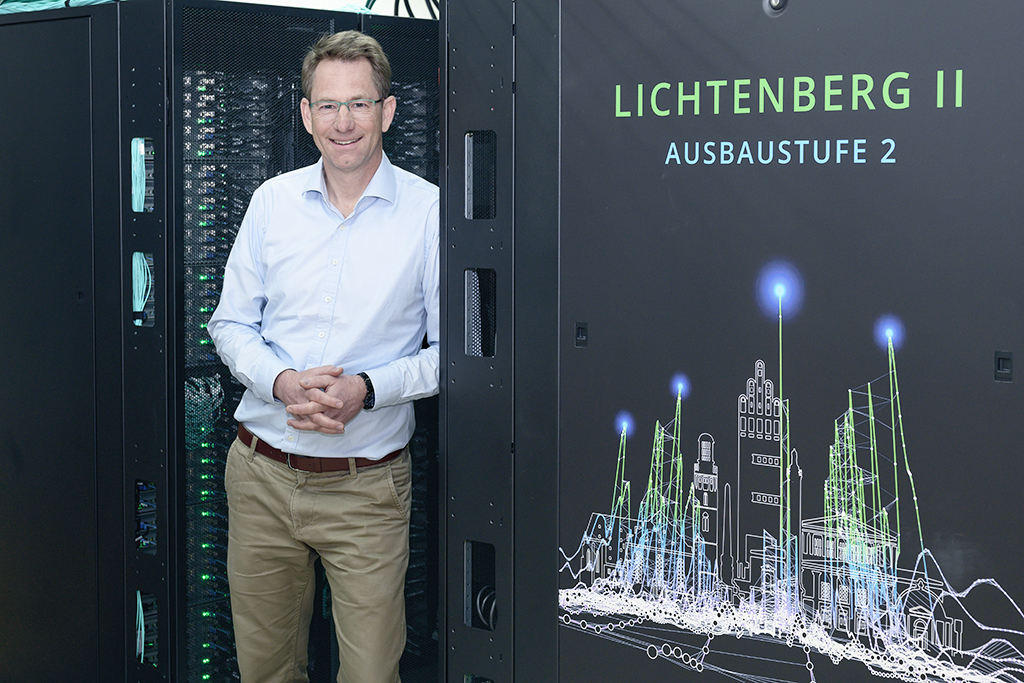
As an engineer, the professor of mechanical engineering combines practical challenges with scientific curiosity, for example, by researching how turbulence affects the structure and stability of hydrogen flames. At TU Darmstadt, Hasse is working very successfully on modelling and simulating innovative energy conversion processes. His current research focuses on hydrogen and metals as carbon-free energy sources. He was the first scientist to develop and validate flamelet models for the reaction zone structure of unstable hydrogen flames and use them in a pioneering way in his simulations. Christian Hasse and his team are among the few groups worldwide that have qualified to use Europe’s first exascale supercomputer, ‘JUPITER’. Their ongoing direct numerical simulations decipher the complex dynamics of lean turbulent hydrogen flames on nanosecond and micrometer scales under realistic operating conditions. This research offers key insights into safety-critical phenomena, such as flame flashback, and lays the foundation for the safe and efficient operation of future CO₂-free hydrogen gas turbines.
Christian Hasse has also successfully established himself as an outstanding scientist in research on metals as recyclable energy carriers. As the initiator and leader of the interdisciplinary joint project ‘Clean Circles’, which brings together more than 20 principal investigators, he is significantly advancing this dynamically growing field of research. He systematically combines his excellent disciplinary research with materials science and chemistry. Christian Hasse’s international leadership position is also evidenced by the ERC Advanced Grant ‘A-STEAM’ (Aluminum steam combustion for clean energy), in which he is investigating the thermofluid dynamic fundamentals of the reaction of aluminium particles with steam – an innovative and highly promising approach to the clean generation of high-temperature heat and hydrogen.
The prize will be awarded at a ceremony next March.